There is something wonderfully paradoxical about farce. What appears to be an effortless succession of mishaps and misunderstandings demands an extraordinary degree of precision from those responsible for bringing it to life. Michael Frayn’s Noises Off, performed at Newcastle’s People’s Theatre, embraces this contradiction with utter enthusiasm, delivering an evening of gloriously orchestrated chaos. For a community theatre whose productions are sustained by the dedication and collective efforts of its members, there is something especially fitting about staging a comedy that celebrates the absurdities of theatrical endeavour.
Frayn’s play follows a dysfunctional company of actors attempting to stage Nothing On, a fictional farce whose increasingly disastrous performances expose the tensions brewing behind the scenes. Across three acts, we witness a troubled dress rehearsal, the backstage pandemonium of a subsequent performance, and the eventual collapse of the production into total disarray. It is an ingenious dramatic construction, relying upon repetition and escalating misunderstandings to transform seemingly inconsequential details into moments of extraordinary comic significance.
Under the direction of Kaila Moyers, the People’s Theatre company approaches this demanding material with remarkable assurance. The intricate choreography of entrances, exits and slamming doors is executed with impressive precision, becoming increasingly extraordinary as the production progresses. Indeed, the success of Noises Off depends upon an almost contradictory theatrical discipline: while the fictional performers descend into disarray, the actors portraying them must remain impeccably coordinated. Moyers navigates this challenge beautifully, allowing the comedy to develop organically rather than forcing its humour upon the audience. Admittedly, the opening ten minutes, with their distinctly traditional sitcom sensibilities, initially left me wondering whether the production would be quite my cup of tea. By the second act, however, I was thoroughly converted, frequently finding myself laughing out loud.
Much of this success rests upon the strength of the ensemble, whose collective commitment to the absurdity of Frayn’s writing is consistently impressive. Roger Liddle delivers a delightfully exaggerated performance as Selsdon, while Allison Carr’s Dotty brings a wonderfully spirited physicality to the proceedings. Ginny Leigh is equally entertaining as Poppy, whose increasing involvement in the company’s backstage calamities provides some particularly amusing moments. For me, however, Glen Kingston’s Lloyd is the evening’s standout performance. As the fictional director desperately attempting to maintain some semblance of authority, Kingston commands the stage with magnificent exasperation, his increasingly strained composure becoming a source of considerable amusement. His interactions with Jay Hindmarsh’s Tim Allgood are particularly entertaining, capturing the familiar theatrical dynamic between an increasingly demanding director and his beleaguered colleague.
Elsewhere, Jess Chapman excels as Belinda, particularly during the second act, when her attempts to contain the company’s mounting disasters become increasingly desperate. The contrast between the characters’ onstage personas and their backstage relationships provides much of the production’s humour, with Annie Elizabeth Cairns’ apparent passivity during Nothing On giving way to considerably more emotionally charged behaviour behind the scenes as Brooke. Peter Dawson’s Frederick Fellows demonstrates an admirable commitment to physical comedy, particularly during his repeated trouser-related misfortunes, while Robbie Close’s Gary throws himself into the production’s more demanding physical sequences with extraordinary conviction. His tumble down the staircase is as impressive as it is hilarious.
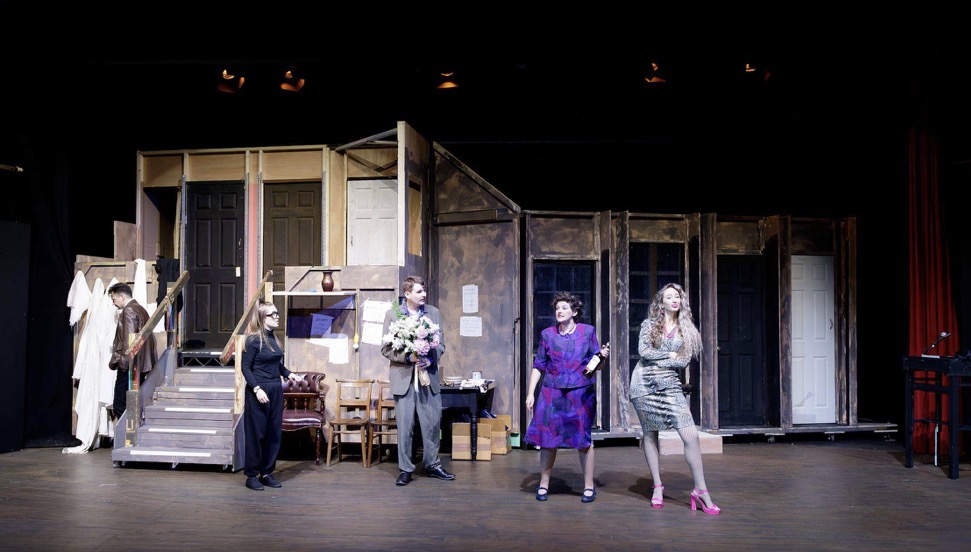
The production’s technical accomplishments deserve equally enthusiastic recognition. Designed and built by Stepen Appleby and Andrew De’Ath, the set initially presents a wonderfully cosy, lived-in domestic interior, complete with a sofa, staircase and an imposing collection of seven doors. Its apparent simplicity conceals an ingenious construction, with the entire structure physically turned around between acts to reveal the backstage perspective. Watching the stage management team undertake this considerable transformation by hand during the intervals offers a particularly tangible reminder of the labour involved in community theatre. Every door, staircase and carefully positioned prop contributes to the choreography of the comedy, while the seemingly endless appearances of plates of sardines become increasingly ridiculous as the evening unfolds.
The second act is undoubtedly the production’s comic triumph. With the audience now privy to the backstage machinations of Nothing On, familiar sequences acquire entirely new meanings, and the increasingly frantic attempts to preserve the illusion of theatrical professionalism are met with uproarious laughter. What makes this sequence particularly effective is the company’s ability to sustain its momentum without sacrificing clarity. Even as the action becomes more physically elaborate, the timing remains impressively controlled. By the final act, the cumulative absurdity of the situation has reached its natural conclusion, with the audience’s enthusiastic response reflecting the considerable success of the production’s carefully constructed comic rhythm.
There is something so endearing about watching Noises Off at the People’s Theatre. Beneath the slamming doors, misplaced sardines and increasingly catastrophic performances lies a celebration of the collaborative spirit that makes theatre possible. The dedication of the performers, creative team and those working tirelessly behind the scenes is evident throughout, lending this production a warmth that feels particularly appropriate to its community theatre setting. Moyers and her company have delivered an accomplished, tremendously entertaining interpretation of Frayn’s theatrical farce, demonstrating that even the most spectacular onstage disasters require an extraordinary amount of work to get exactly right.
Image credit – Paul Hood


Leave a Reply