FIVE STARS
As the clocks prepare to turn back and evenings grow darker, there could hardly be a more fitting time to indulge in a good old-fashioned ghost story. With Halloween fast approaching, the People’s Theatre has embraced the season with a chilling production of Danny Robins’ 2:22 A Ghost Story, delivering an evening of suspense, supernatural intrigue and quite extraordinary theatrical craftsmanship.
Having seen several iterations of 2:22 over the years, amid its seemingly endless rotation of celebrity and stunt casting in the West End, I was particularly intrigued to discover how the People’s Theatre would approach a production so heavily reliant on technical precision, atmospheric staging and the orchestration of suspense; I am pleased to let you know that the result was nothing short of astonishing.
Any good ghost story demands one thing of its audience: secrecy. 2:22 is certainly no exception. The play follows Jenny (Holly Stamp), a new mother who has recently moved into a renovated house with her husband, Sam (Sam Hinton), and their baby daughter, Phoebe. While Sam is away on a work trip, Jenny begins experiencing a series of inexplicable disturbances, occurring at precisely 2:22 each morning. Convinced that something supernatural is haunting their home, she seeks answers, only to find her sceptical husband decidedly unconvinced. When the couple host their old friend Lauren (Kay Edmundson) and her new partner Ben (Sam Burrell) for an evening of dinner and drinks, Jenny persuades the group to stay awake until 2:22 to witness the phenomenon for themselves. What follows is an increasingly tense exploration of belief, scepticism, relationships and the things that occur in the night.
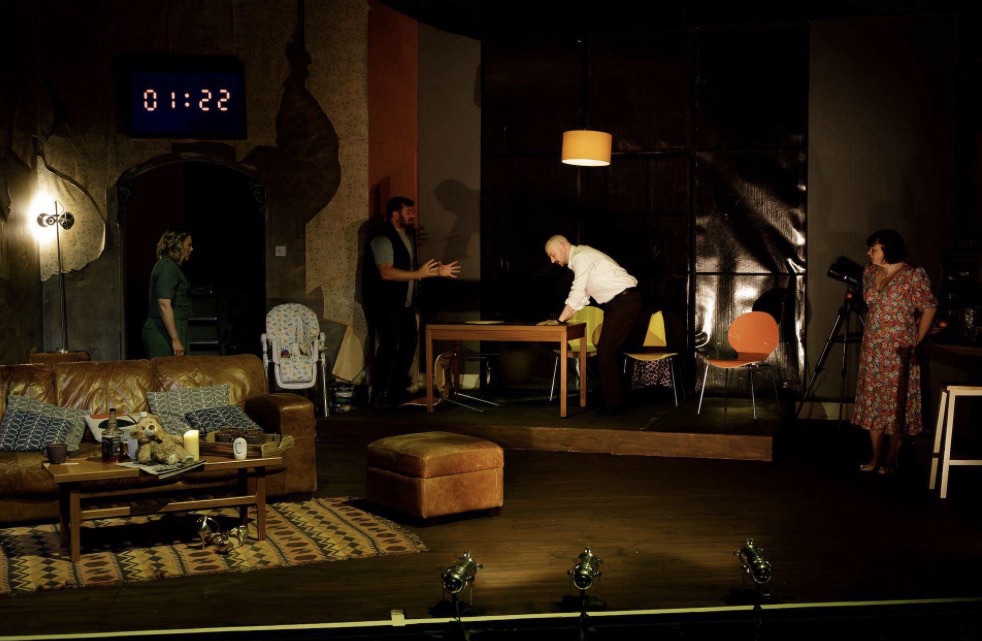
Undoubtedly, the most striking feature of this production was the immense feat of set design accomplished by the vision of Sands Dobson. Having witnessed the various West End incarnations of 2:22, I was astonished by just how closely this staging resembled its commercial counterparts, both in its architectural ambition and the extraordinary attention paid to its finer details. Indeed, in some respects, Dobson’s interpretation felt even more convincingly lived-in.
Despite having attended numerous productions at the People’s Theatre, I cannot recall encountering a set quite so elaborate. An entire domestic interior had been constructed with remarkable intricacy, from a staircase ascending towards a cleverly concealed upper floor to glass-panelled doors revealing an outdoor space scattered with greenery. A fully realised kitchen (with a functioning kettle and tap) occupied stage left, while a bathroom sat stage right. Every room felt purposeful, every furnishing carefully considered, and every architectural detail contributed to the illusion of an inhabited family home.
It was a remarkable achievement, not simply in its visual resemblance to the West End productions, but in the sheer scale of its construction. Dobson’s design, brought to life by an extensive team of builders, painters and set dressers, transformed the stage into an environment that felt tangible, familiar and, consequently, all the more vulnerable to supernatural intrusion. There is something particularly unsettling about watching the extraordinary unfold within surroundings that feel so convincingly ordinary.
Equally integral to the production’s success was Tracey Lucas’ accomplished sound design. Anybody familiar with 2:22 will appreciate that sound is not merely an atmospheric accompaniment to the action; it is fundamental to the very mechanics of the play. The production’s carefully calibrated soundscape sustains tension, punctuates moments of apparent normality and manipulates the audience’s anticipation with remarkable effectiveness.
From the crackling murmurs of baby Phoebe over the monitor to the precisely orchestrated jump scares, every auditory intervention felt meticulously timed. In a production of this nature, even a momentary delay between an actor’s reaction and its accompanying sound effect risks undermining the illusion entirely. Lucas’ design demonstrated an exceptional understanding of this relationship, ensuring that the technical and dramatic elements remained in perfect synchronisation. The result was an atmosphere of mounting unease that kept the audience perpetually alert to the possibility of something lurking beyond their sight.
Of course, such technical accomplishment would mean little without a cast capable of sustaining the play’s emotional and psychological tensions. Fortunately, the four central performers proved more than equal to the challenge.
As Lauren, Kay Edmundson delivered a wonderfully assured performance, navigating the character’s increasingly uninhibited behaviour with considerable comedic flair. Particularly impressive was her convincing portrayal of drunkenness, which developed organically throughout the evening without ever descending into caricature. As the alcohol flowed and Lauren’s flirtatiousness became increasingly pronounced, Edmundson maintained a careful balance between humour, vulnerability and the underlying tensions of the group’s relationships.
Sam Burrell offered an intriguingly likeable interpretation of Ben, bringing warmth and an appealing sincerity to a character whose presence introduces a different perspective into the evening’s escalating debate. His performance provided a welcome counterbalance to the more confrontational personalities surrounding him, lending additional dimension to the dynamics of the group.
Sam Hinton, meanwhile, was fabulously commanding as Sam. His portrayal was particularly effective in charting the character’s gradual decline in likeability as the evening progressed. Initially presenting himself as the voice of rationality, Sam’s unwavering scepticism increasingly gives way to an arrogance that threatens to alienate both his wife and the audience. Hinton handled this transformation with considerable confidence, allowing the character’s less appealing qualities to emerge naturally rather than imposing them prematurely. It was a thoroughly convincing performance, made all the more impressive by his ability to sustain the character’s authority even as our sympathies began to shift elsewhere.
The standout performance, however, belonged to Holly Stamp as Jenny. Tasked with carrying much of the production’s emotional weight, Stamp delivered a remarkably affecting portrayal of a woman caught between mounting terror and an unwavering determination to protect her family. Her oscillation between frightened fragility and the fierce courage of a mother motivated by love was quite astonishing. There was a humane quality to her performance, ensuring that Jenny remained sympathetic and believable even as the supernatural circumstances surrounding her became increasingly extraordinary. Stamp’s emotional sincerity provided the production with its beating heart, grounding the spectacle of the ghost story in something altogether more moving.
Under the direction of Anna Dobson, assisted by Joe Moore, these performances came together with extraordinary precision. Ghost stories of this nature depend upon a degree of theatrical cohesion that is remarkably difficult to achieve. Every movement, prop placement, paranormal disturbance, line delivery and frightened reaction must operate in careful concert, with even the smallest inconsistency threatening to puncture the suspense.
Here, however, the production demonstrated an exceptional confidence in both Robins’ script and the relationship between its creative elements. Dobson’s direction allowed the story to unfold with a measured sense of inevitability, maintaining the play’s humour and conversational naturalism while gradually tightening its grip on the audience. Nothing felt incidental; every element appeared carefully crafted to serve the larger dramatic effect.
Perhaps the greatest testament to this achievement came during the play’s climactic revelation. As the truth emerged, an audible, collective gasp swept through the auditorium. It was a wonderful moment of shared theatrical astonishment, and one that spoke volumes about the production’s success. To elicit such a spontaneous response from an audience requires more than a clever twist: it demands an entire evening of carefully sustained investment. At that moment, Dobson and her company had the audience firmly in the palms of their hands.
The People’s Theatre has delivered yet another five-star triumph. With its extraordinarily ambitious set, impeccable technical execution and a quartet of compelling performances, this production of 2:22 A Ghost Story is a formidable demonstration of what can be achieved through theatrical ingenuity, collaboration and meticulous attention to detail.
Seasonally appropriate, wonderfully unsettling and relentlessly entertaining, it is a marvellous way to embrace the darker evenings. A genuinely fabulous evening of theatre, and one that proves you needn’t travel to the West End to experience theatrical craftsmanship of the highest calibre.
Image credit – Paul Hood via People’s Theatre.


Leave a Reply