As yet another Fringe season draws to a close, what better way to celebrate than by squeezing in one final show? Right Track Theatre’s Off and On is a new comedy written and directed by Ben Cawood (assisted by Alice Fenton) and produced by Robyn Bradbury (assisted by Olivia Higgins-Darby); I was fortunate enough to catch the final performance of its national tour back where it all started, in Durham.
Set in the 1980s, Off and On follows a frazzled Minister of Transport who boards the overnight sleeper to Leeds with the intention of delivering his resignation speech the following morning. Naturally, very little goes according to plan. A thoughtless late-night liaison with the train’s conductor triggers a spiralling chain of mistaken identities (complete with the costume swaps), emotional outbursts, unintended affairs and frantic cover-ups. Stake are high, and each spiralling lie told to conceal the previous one pushes the train further and further off the rails.
With something so unabashedly farcical, the greatest challenge comes in ensuring that its gags provoke belly laughs rather than rolled eyes. I am thrilled that Cawood and Fenton’s direction consistently facilitates the former. Exaggerated mannerisms are paired with an almost forensic precision of movement, meaning that even as the narrative descends further into absurdity, the production itself never loses control. Background action is afforded as much attention as whatever happens to occupy the centre of the scene. One particular highlight comes in the ever-increasing drunkenness of journalist Simon, who at one point downs four glasses of wine in rapid succession while the principal action continues elsewhere. It is a small detail, but indicative of the care afforded to every corner of the production: when somebody is on stage, there is rarely a gesture, reaction or movement left untouched.
Cawood also takes on the considerable challenge of staging the production in traverse, transforming the performance space into the notoriously narrow aisle of a moving train. Aboard a British Rail service to Leeds, this is one of the most impressive concepts I have encountered on the Fringe circuit, and its execution within Durham Castle was excellent. I can only feel jealous of those lucky enough to have seen the production performed aboard an actual train earlier in its tour.
More importantly, the traverse extends beyond aesthetic gimmick; it actively contributes to the mechanics of the farce. Characters squeeze past one another, disappear off-stage, re-emerge in increasingly ridiculous circumstances and conduct clandestine exchanges while the audience sits only feet away. Unlike something akin to Cockfosters, similarly situated within the world of public transport but staged more conventionally, Off and On uses the physical limitations of its setting to its advantage. The proximity creates a wonderfully claustrophobic quality: there is quite literally nowhere for these characters, or their increasingly elaborate lies, to hide. It breathes further believability — if such a thing can be said of a plot involving quite this many corpses and costume changes — into the world of the show.
The cast’s diction is equally astonishing, particularly given the speed required to sustain the satire without allowing it to collapse into craftless chaos. While the action is deliberately frantic, every movement, word and accent feels measured. Lines fly between performers without becoming muddied, and each word is enunciated and projected clearly enough to compete with the Cathedral bells ringing relentlessly, all without microphones. It may seem a superfluously technical point, but in a comedy so dependent upon verbal misunderstandings, rapidly escalating lies and perfectly timed revelations, clarity is vital. The strength of the cast in this regard elevates the professionalism and subsequent standard of the production enormously.
Alongside this precision comes relentless energy. From on-stage costume changes to faked deaths, real deaths, physical comedy, intimacy and everything in between, Off and On asks an enormous amount of its nine-strong cast. Yet, each performer attacks the material with absolute commitment. Farce necessitates precisely this: anything performed by halves risks feeling lazy or awkward, particularly when the material itself is intentionally ridiculous. Fortunately, there is no trace of hesitation here. However ludicrous the situation becomes, the cast commit to it as though their lives — or, perhaps more appropriately, their careers and political reputations — genuinely depend upon it.
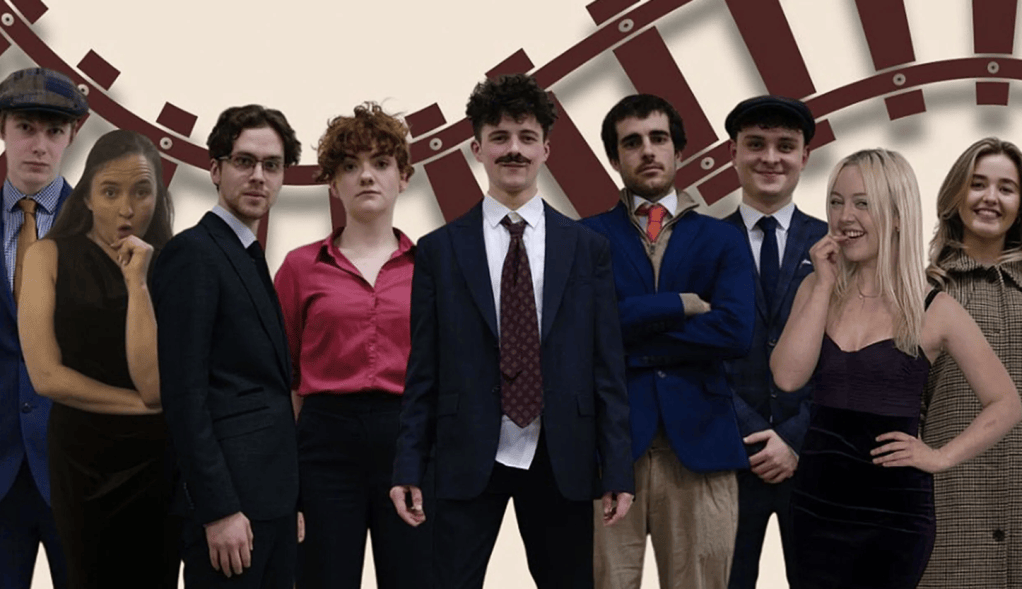
Every member of this nine-strong ensemble is given a named and substantial role, and together they are instrumental in pulling the increasingly elaborate machinery of the piece into place. Leading the charge, Sam Gordon-Webb offers a side-splittingly familiar image of the scrambling politician, desperately attempting to retain some semblance of authority while everything around him disintegrates. His performance is wonderfully self-important without becoming monotonous, allowing each successive humiliation to land all the more effectively. Opposite him, Christine Williams demonstrates fantastic versatility as Judith Murrey. If the phrase ‘jack of all trades’ could be applied to any theatrical role, it would undoubtedly be Judith; Williams navigates each new demand placed upon her with hilarious ease.
Arbennik Webster’s Simon becomes increasingly endearing as his alcohol consumption rises and his ability to comprehend the gravity of the situation around him correspondingly diminishes. Emilia Lewis, meanwhile, provides one of the production’s more unexpected emotional touchstones towards its conclusion, momentarily stretching the narrative towards something approaching sincerity before, inevitably, comedy comes crashing back in. Jay Raj Chaudhry is another highlight as the perpetually flustered train guard, repeatedly whisked into situations engineered by those around him and left to contend with their consequences. Chaudhry’s exasperation is particularly well judged: surrounded by characters seemingly determined to make his job impossible, his reactions often become as funny as the chaos itself.
Perhaps the strongest comic pairing, however, comes from Antoine Vander Elst as Hemingway, the morally dubious Managing Director of British Rail, and Elliott Eardley as Eddy. The two are excellent both independently and together, but truly come into their own as the plot grows more preposterous in the latter half. Vander Elst gives Hemingway a brilliantly slippery authority, maintaining the outward confidence of a man accustomed to wielding power even when his circumstances become increasingly indefensible. There is something wonderfully pompous about him, making every indignity inflicted upon the character infinitely funnier.
Eardley, meanwhile, makes Eddy one of the production’s most immediately likeable comic presences. His willingness to throw himself headfirst (often literally) into each increasingly ludicrous development gives the performance an infectious energy, particularly as Eddy becomes indispensable to the elaborate attempts to keep the evening’s scandals concealed. Together, Eardley and Vander Elst establish a fantastic comic rhythm, bouncing between panic, indignation and sheer absurdity without losing the clarity of the scene. By the time forged deaths and swapped identities begin piling upon one another, there is an element of predictability to where certain jokes are heading, but this feels largely purposeful. Farce thrives upon an audience seeing disaster approaching several moments before its characters do, and much of the joy here comes from watching Hemingway and Eddy barrel towards the inevitable anyway.
The female characters are, unfortunately, somewhat less generously written, often existing primarily in relation to the men around them. Within the Thatcherite world in which Off and On is situated, there is certainly scope to read this as an intentional reflection of the gender politics of its setting, but there remain moments in which I yearned for the women to be afforded greater comic agency of their own. Bethan Avery nevertheless makes Paula Hemingway hilarious, particularly when navigating the production’s increasingly scandalous affair plots, while Amaya Clarke executes the flirtatious comedy of Stacy brilliantly. Her work during the Lambrusco sequence is particularly funny, and only made me wish the character had been given more opportunity to exist beyond her relationships with the men surrounding her.
Costume design by Fleur Simpson is similarly instrumental in constructing the world of the production. The gold name badges add a polished, professional edge to otherwise immediately familiar uniforms, but costume takes on a much greater significance once the mistaken identities begin. With so much of the comedy dependent upon characters exchanging clothes, the design has to operate on three levels simultaneously: believable, comedic and, crucially, practical. The red tie and black suit combination feels quintessentially railway — almost LNER-esque to a contemporary eye — while shirts, jackets and trousers can be swapped quickly enough to sustain the pace of the action.
The decision to clad both the Transport Minister and Managing Director in navy is another particularly effective touch. There is something immediately recognisable about the sombre navy uniform of political respectability, and here it helps visually align two men whose authority becomes increasingly ridiculous as the evening progresses. Elsewhere, the scripted fake moustache wonderfully heightens the absurdity of the identity swaps, while the leading female characters’ conservative dress works in tandem with that of their partners to immediately establish the social world these characters inhabit.
Ultimately, Off and On is a feat of comic precision of which the entire company ought to be immensely proud. Its greatest achievement lies in the tension between apparent chaos and meticulous control: entrances are made at precisely the right moment, identities become confused without the audience losing track, costumes migrate between characters and increasingly implausible lies accumulate until there is seemingly no possible route out.
Much like their name suggests, Right Track Theatre are very much on the right track, with Off and On demonstrating a company with an exciting instinct for ambitious, unapologetically theatrical comedy. Rooted firmly in the traditions of British farce while refusing to feel like a museum piece, it finds humour capable of transcending generations. If you are willing to leave your inhibitions on the platform, suspend your disbelief and climb aboard, Off and On offers one wonderfully ridiculous journey.
Image credit – Right Track Theatre


Leave a Reply