Amidst a dreary week of rain in the North-East, The Last Laugh has arrived at the Darlington Hippodrome to brighten the mood. Admittedly, I am a little before the generation most likely to be familiar with Tommy Cooper, Eric Morecambe and Bob Monkhouse. While much of the audience delighted in the immediate recognition of familiar mannerisms, catchphrases and comic routines, I came to The Last Laugh without that same nostalgic attachment. In many ways, however, this provides an interesting test of Paul Hendy’s play: stripped of the affection already attached to these three comedy giants, does The Last Laugh still work as a piece of theatre in its own right? I am here to let you know that it absolutely does.
Set entirely within a small dressing room, The Last Laugh has little in the way of a conventional plot. Instead, Cooper, Morecambe and Monkhouse meet, dress and talk. They trade jokes, discuss their careers, contemplate the peculiarities of comedy and gradually reveal something of the men who existed behind their carefully constructed public personas. Hendy originally pieced the work together as a tribute of sorts, with each performer embodying one of their own comedy heroes, but the result reaches beyond impersonation. The Last Laugh becomes an affectionate ode to comedy itself: to those who perform it, those who consume it, and the strange relationship between laughter and the lives of the people responsible for producing it.
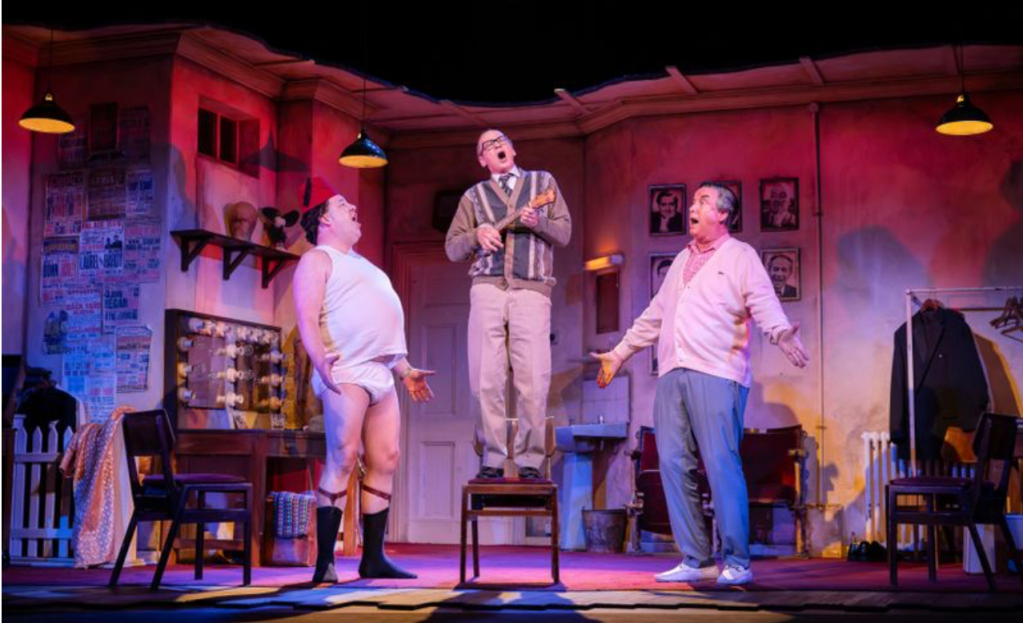
The play’s greatest strength lies in its tonal intricacy. While a comedy both in name and nature, its fascination with laughter is accompanied by a surprising degree of poignancy. The dressing-room walls are lined with photographs of comedians past, situating Cooper, Morecambe and Monkhouse within a much broader comic history. Initially, these faces might seem like part of the room’s clutter; increasingly, however, they become a reminder of the lineage to which these men belong and the inevitable mortality lurking behind a profession devoted to making other people laugh, being tied directly into the dialogue in order to draw the audience’s attention to this.
This balance of humour and poignancy is particularly impressive across a 90-minute, interval-free runtime. A play built predominantly around three men talking in one room could easily become either overextended or dramatically sparse, yet Hendy’s writing avoids both. The jokes arrive consistently without reducing the characters to vehicles for punchlines, while the more reflective passages are given enough space to resonate without overwhelming the warmth at the centre of the piece. Crucially for those without an encyclopaedic knowledge of British comedy (such as myself), the humour rarely feels dependent upon recognition alone. There may be another layer available to those who know exactly what is being recreated, but there is still plenty here for everybody else.
Music plays an important role in maintaining that tonal balance. A couple of light-hearted songs are woven through the action, incorporating instruments and showcasing the versatility of the three performers while retaining the easy informality of the dressing-room setting. Elsewhere, however, music takes on a more contemplative function. Gentle keys and strings underscore moments of reflection, subtly shifting the atmosphere without forcing sentimentality onto them.
Also working as director, Paul Hendy ensures that the production never feels static. With only three performers, one room and relatively little narrative action, characterisation becomes essential, and the production establishes three remarkably distinct presences. Their physicality and interactions continually animate the space, meaning that what could essentially amount to an extended conversation instead feels theatrically vibrant. More importantly, the direction allows quieter moments to sit comfortably beside the larger comic performances. These are recognisable comedy personas, certainly, but they are also permitted moments of stillness in which something more human can emerge.
Even the costume – designed by Amy Chamberlain – contributes to this progression. The opening sight of Tommy Cooper in underwear and a white vest earns an immediate laugh, exploiting the inherent absurdity of seeing this supposedly iconic figure in this way. Yet there is something rather clever in the way costume develops thereafter. As the three men become properly dressed, their conversation becomes increasingly revealing. The production almost inverts the expected relationship between clothing and vulnerability: they are at their most physically exposed at the beginning, but increasingly emotionally exposed as layers of costume are added.
Of course, none of this would succeed without the strength of its three-man cast. Damian Williams’ Tommy Cooper perhaps generates the most consistent laughter, his physicality lending itself wonderfully to Cooper’s more immediate, slapstick style of comedy. There is something wonderfully ridiculous about his presence, and Williams understands precisely how long to hold a movement or expression before allowing the joke to land.
Simon Cartwright brings a different energy to Bob Monkhouse, capturing the polish and precision of a performer whose relationship with comedy feels markedly different from Cooper’s. The contrast between the three men is crucial to the play’s success: they are not simply three variations on the same nostalgic comic archetype, but distinct personalities with different approaches to performance and laughter.
Steve Royle completes the trio as Eric Morecambe, bringing an infectious warmth to the dressing room. His comic timing is superb, but it is perhaps his laugh that proves most memorable: so wonderfully distinctive that it becomes funny in itself. Royle’s performance helps establish the easy chemistry upon which so much of the production depends, allowing the conversations between the three men to feel spontaneous even as Hendy’s writing carefully guides them towards more reflective territory.
There will undoubtedly be something particularly special about The Last Laugh for audiences who grew up with Cooper, Morecambe and Monkhouse. Around me, recognition frequently seemed to arrive before a joke had even fully landed, with familiar gestures and mannerisms provoking delighted responses of their own. Yet, perhaps the production’s greatest compliment is that this familiarity is not a prerequisite.
I entered the theatre without any meaningful nostalgia for the three men at its centre and emerged understanding, at least a little more, why so many others do. The Last Laugh does not require its audience to arrive already loving its subjects. Beneath the impressions, familiar routines and affectionate references is a genuinely thoughtful play about comedy: why we need it, what it demands of those who dedicate their lives to it, and what remains once the laughter eventually stops.
The Last Laugh is running at the Darlington Hippodrome until Saturday 22 August, 2026. Get your tickets here.
Image credit: Pamela Raith


Leave a Reply