After a long couple of months balancing full-time work with a full-time Master’s degree, I am delighted to be back in regional theatres around the North-East. This week, I tumbled out of bed and stumbled to the Darlington Hippodrome for the latest UK tour of 9 to 5: The Musical, Dolly Parton’s infectiously joyful celebration of resilience, friendship and sticking it to the patriarchy.
Set in 1980s America, the musical follows office workers Violet, Doralee and Judy as they navigate sexism, workplace discrimination and the suffocating authority of their chauvinistic boss, Franklin Hart Jr. What begins as a tale of three women brought together by circumstance quickly blossoms into an uplifting story of empowerment and finding the courage to demand better.
Above all else, 9 to 5 is a glorious night out at the theatre. While not strictly a jukebox musical, it effortlessly captures the same infectious energy, centred around Dolly Parton’s iconic title number whilst allowing Patricia Resnick’s witty book and Parton’s original score to propel the narrative organically forward. It neatly avoids one of the genre’s most common pitfalls: rather than pausing for recognisable hits at the expense of storytelling, every musical number serves the narrative. The familiar melodies are woven naturally into the fabric of the show, and although Dolly herself pops up throughout in a series of delightful cameos, the production never becomes a concert masquerading as theatre. Instead, it remains a fully realised musical that offers plenty for devoted Dolly fans whilst standing confidently in its own right.
Amanda Stoodley’s design embraces practicality, clearly prioritising the demands of touring. The set is intentionally sparse, divided across two levels with an elevated upstage platform and a largely open playing space below. Rolling office desks glide seamlessly across the stage, allowing scenes to transition with remarkable fluidity and maintaining the production’s brisk pace. There is an undeniable ingenuity in such simplicity. Yet, for a musical of this scale, the design occasionally felt too restrained. The fabric-covered screens, in particular, lacked the polish found elsewhere in the production and, at times, gave proceedings a surprisingly budget appearance. One couldn’t help but wish for a little more visual texture to match the exuberance of the material.
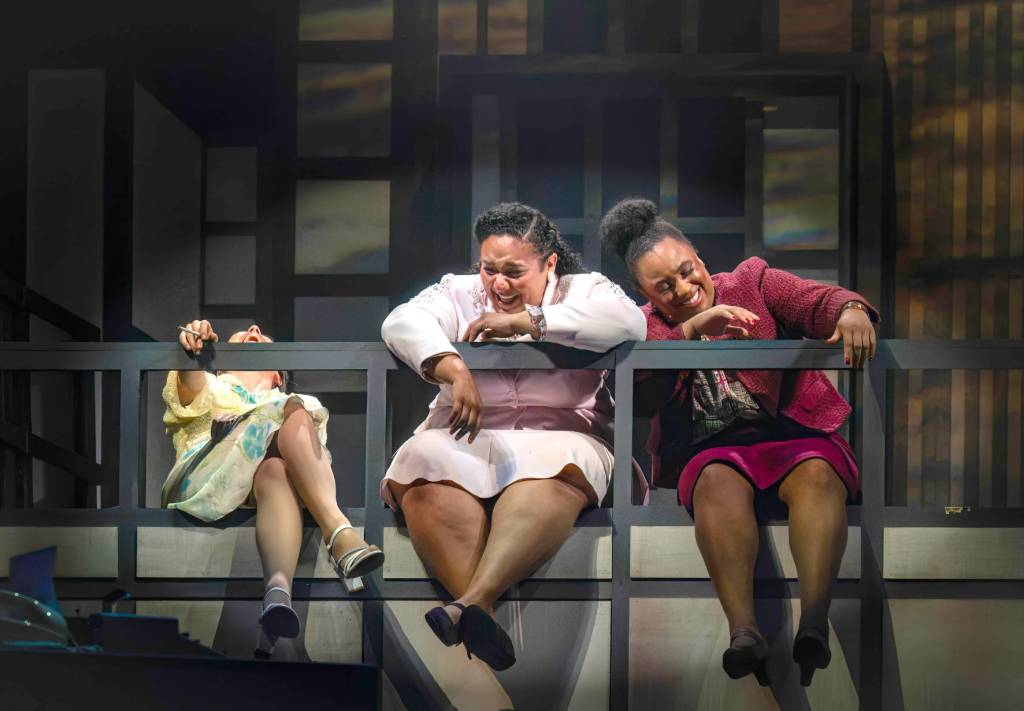
Where Stoodley’s design truly excelled, however, was in its costume work. Costume became one of the production’s strongest storytelling devices, communicating character with remarkable subtlety. The monochromatic sea of muted office attire made Judy’s arrival in vibrant pink all the more striking, immediately signalling her status as an outsider entering an unfamiliar world. Jessica Martin’s costumes were wonderfully layered, complementing her eccentric performance, whilst Karla Tracey’s wardrobe perfectly balanced Doralee’s trademark femininity with tasteful restraint, her pastel ensembles capturing the warmth and sincerity of the character without tipping into cute caricature.
The performances were consistently excellent, injecting the production with precisely the right balance of humour and emotional sincerity. Tim Rogers’ Franklin Hart Jr. was magnificently unlikeable, transforming what could easily become a cartoon villain into someone genuinely unpleasant whilst never sacrificing the comedy that makes the character so entertaining to watch.
Jade Marvin anchored the production beautifully as Violet, charting her character’s emotional journey with warmth and authority. Her rendition of One of the Boys proved one of the evening’s vocal highlights, offering a nuanced glimpse into Violet’s frustrations beneath her composed exterior. Karla Tracey’s Doralee radiated effortless charm throughout. Her commitment to character extended far beyond her dialogue, evident even in the smallest physical details; the distinctive way she hurried on and off stage became a delightful piece of characterisation that remained consistently engaging throughout the evening.
Perhaps the standout performance, however, came from Kayla Carter as Judy. Having previously had the pleasure of seeing Carter in productions including RENT and Military Wives, it came as little surprise that she delivered once again. Nevertheless, her vocal performance here surpassed even the highest expectations. Get Out and Stay Out was nothing short of sensational, bringing the house down with a thrilling display of power and emotional conviction.
The ensemble deserve equal recognition. With relatively little scenery to create a lived-in office environment, much of that responsibility fell to the performers themselves, and they rose to the challenge superbly. Every movement felt considered, every formation precise, from the razor-sharp musical theatre jazz of One of the Boys to the tightly choreographed office sequences that injected life into every corner of the stage. Their versatility and precision never faltered.
Paul Jepson’s direction similarly impressed, particularly in his handling of the central relationships. The shifting dynamics between Hart and the three protagonists were expertly paced, balancing moments of genuine tension with the show’s irrepressible sense of fun. Characterisation throughout felt carefully judged, allowing the comedy to flourish without undermining the emotional stakes. There were, however, occasional moments where directorial choices felt less successful. The use of torches during one Act One sequence, for instance, appeared largely superfluous, with the stage lighting already illuminating the action to such an extent that any intended dramatic effect was somewhat lost.
Nearly half a century after its setting, 9 to 5 remains remarkably relevant. Beneath its glittering score, infectious humour and laugh-out-loud one-liners lies a story whose themes continue to resonate with uncomfortable familiarity. It may be wrapped in shoulder pads, big hair and Dolly Parton’s unmistakable charm, but its message of solidarity and refusing to settle feels every bit as urgent today as it would have done in 1980.
Image credit – production image provided by the Darlington Hippodrome via the production company.


Leave a Reply