Last night, I had the pleasure of venturing to Newcastle’s beloved People’s Theatre for a performance of The Curious Incident of the Dog in the Night-Time. Based on the novel by Mark Haddon and adapted for the stage by Simon Stephens, this is a story that has resonated with audiences for over two decades. There is something especially fitting about it finding a home at People’s Theatre: a play so deeply concerned with human experience, empathy and community feels perfectly suited to a venue built upon those very principles.
The story follows fifteen-year-old Christopher Boone as he navigates a predominantly neurotypical world as a neurodivergent young person. When he discovers his neighbour’s dog, Wellington, lying deceased in the garden, Christopher becomes determined to solve the mystery of who killed him. What begins as a detective story soon evolves into something far more profound, uncovering difficult truths about family and identity. While the production engages with themes of grief, betrayal and isolation, it remains at its heart a hopeful and compassionate story, balancing moments of humour with genuine emotional weight.
The production’s greatest strength lies in its complete immersion into Christopher’s world; a testament both to the clarity of Sam Burrell’s direction and the enduring strength of Stephens’ adaptation. From the moment the audience enters the auditorium, it is clear that every creative decision has been carefully considered in service of this vision.
The set, built by Carol English and brought to life by an extensive team of painters, immediately establishes this vision. Framing the stage are blackboard-style panels covered in mathematical equations, diagrams and calculations, inviting the audience directly into the logic-driven world through which Christopher understands his surroundings. It is a simple yet remarkably effective visual choice, instantly grounding us within the character’s mindset, immersing us in his interests.
The wider design elements work seamlessly alongside this concept, complimenting them beautifully. Sam Burrell’s sound design proves particularly effective throughout, with moments of intense auditory overload accompanying Christopher’s experiences of overwhelm. Rather than simply depicting these moments, the production places the audience directly within them. Sudden bursts of sound create a palpable sense of discomfort, fostering a greater understanding of Christopher’s lived experience. Tracey Lucas’ precise operation ensures these moments land exactly as intended, while Tim Swinton’s lighting design further heightens their impact. Multi-coloured flashes and intense strobing effects transform moments of sensory overload into striking theatrical images, creating sequences that are as unsettling as they are visually impressive.
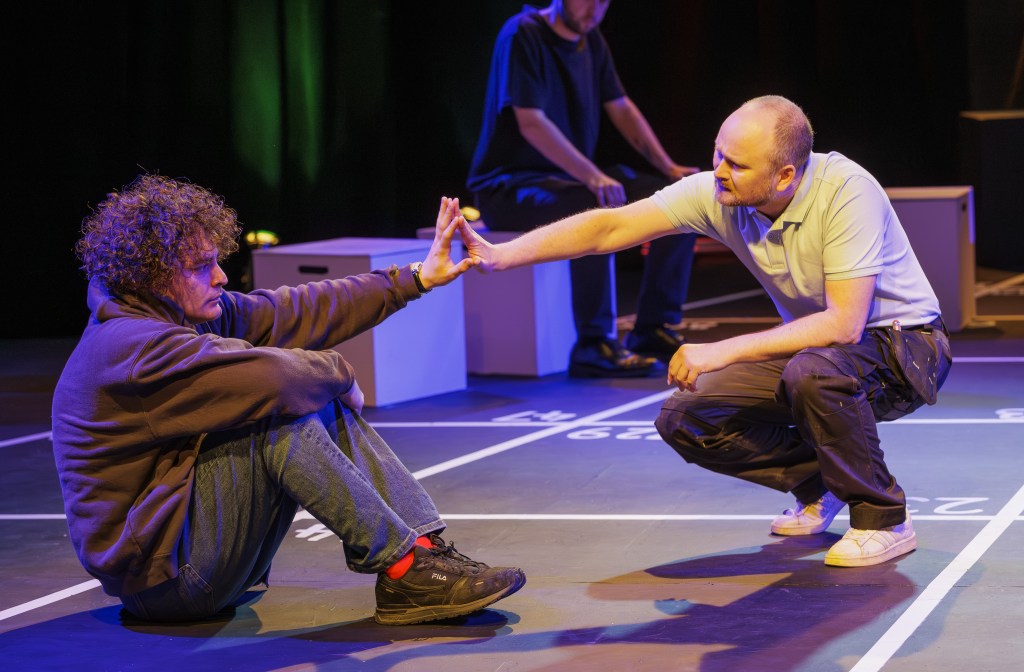
Yet the production’s success extends far beyond its technical achievements. Burrell’s direction repeatedly demonstrates an ability to create expansive worlds through remarkably simple means. The set’s white wooden blocks – familiar to anyone who has spent time in a rehearsal room or drama studio – become the foundation of an astonishingly versatile stage language. Across the evening they transform effortlessly into beds, kitchen counters, front doors, train seats and countless other locations. The result is theatre in its purest form: imaginative, inventive and entirely dependent upon the audience’s willingness to suspend their disbelief. Scene changes flow seamlessly, with the ensemble working in perfect harmony to create an ever-shifting environment that feels both stripped back and expansive.
Of course, such ambitious staging would be impossible without performers capable of bringing it fully to life. Leading the charge in this respect is Zachary Douglas as Christopher Boone, delivering a performance of remarkable consistency and sensitivity. Every movement, gesture and line delivery feels carefully considered, creating a portrayal that remains authentic throughout the production’s considerable emotional demands. Douglas captures Christopher’s matter-of-fact nature and meticulous logic whilst never reducing him to a collection of mannerisms. Instead, he presents a fully realised young person whose determination and vulnerability make him deeply compelling to watch. It is a performance that anchors the entire production.
As Siobhan, Alison Carr serves as both narrator and guide, helping the audience navigate Christopher’s story whilst simultaneously functioning as one of the production’s (and Christopher’s) emotional centres. Her performance is warm, patient and reassuring, embodying the compassion that makes Siobhan such an important figure within Christopher’s life. Carr’s calm presence provides a necessary counterbalance to many of the show’s more intense moments, ensuring the audience always has a point of connection amidst the complexity of the narrative.
Sean Burnside delivers a particularly moving performance as Ed. The role demands significant emotional range, and Burnside rises to the challenge admirably, portraying a father whose love for his son is undeniable despite his own humane flaws and mistakes. His performance captures the frustration, exhaustion and devotion that coexist within the character, lending real emotional complexity to some of the production’s most difficult scenes; as somebody who deeply loves and cares for a sibling with autism, it was a particularly compelling portrayal of my own realities, encompassing the helpless frustration which can often co-exist with the boundless love. Burnside’s performance in this sense was utterly mesmerising.
Sara Jo Harrison is equally impressive as Judy, coming into her own particularly during the second act. Her portrayal is raw, earnest and emotionally nuanced, offering a viscerally human depiction of a mother desperately attempting to rebuild a fractured relationship with her son. Harrison ensures Judy’s motivations are never simplified, instead presenting a character whose mistakes and regrets exist alongside a genuine desire for reconciliation.
The ensemble deserve enormous praise for the precision and versatility their roles demand. Throughout the evening they seamlessly inhabit a multitude of characters, from neighbours and police officers to commuters and passers-by, all whilst serving as the machinery through which Burrell’s directorial vision is realised. Their work is perhaps most striking during Christopher’s journey to London, a sequence requiring immense coordination and physical precision. The result is some of the production’s most visually impressive theatre, transforming a simple stage into a bustling cityscape through movement alone.
What ultimately makes this production such a triumph is the collective effort behind it. Every department, from design and direction to performance and technical operation, works in complete harmony towards a shared vision. In many ways, it serves as a perfect embodiment of People’s Theatre itself: a community-led organisation producing work of extraordinary ambition, passion and quality. This production demonstrates precisely what can be achieved when talented individuals come together in pursuit of great storytelling.
Inventive, moving and exceptionally well-executed, The Curious Incident of the Dog in the Night-Time is a resounding success and another shining example of the remarkable work being produced at People’s Theatre.
The Curious Incident of the Dog in the Night-Time runs at People’s Theatre until Saturday 13 June. You can get your tickets here.
Image credit – Paul Hood.
 @ALEXROYTHEATRE
Leave a comment