In recent years, I have become increasingly enamoured with comedy in its many forms, with improvisation among the most impressive. As a long-time admirer of Showstopper!, being invited to Hoopla’s twentieth anniversary celebrations felt particularly exciting; after all, there is something endlessly fascinating about watching performers build entire worlds out of little more than instinct and audience suggestions.
Dubbed “the capital’s best improv” by The London Evening Standard, Hoopla has spent two decades becoming one of the most significant forces in London’s comedy landscape. What began as a group of friends running practice sessions above a pub has transformed into the UK’s largest improv school and its first dedicated improv theatre. Across twenty years, Hoopla has trained thousands of performers while maintaining the friendly, playful ethos at its core. Its influence stretches far beyond the walls of its theatre. Performers including Athena Kugblenu (Mock the Week, BBC Two; Richard Osman’s House of Games, BBC Two), alongside Monica Gaga (Murder She Didn’t Write, Duchess Theatre), have all emerged through Hoopla’s ecosystem.
To celebrate two decades of this growth, Hoopla has launched an anniversary festival at The Miller in Snowfields, near London Bridge – an intimate venue which serves as Hoopla’s home. There is something rather fitting about celebrating twenty years in an eighty-seat theatre. Despite the scale of Hoopla’s influence today, this setting feels intentionally rooted in where many performers begin: small rooms and intimate audiences.
I was fortunate enough to attend one evening of the festival, with host Monica Gaga summing up the night perfectly as “Scenes, Songs and Shakespeare.” Reviewing improv is notoriously difficult given its very nature; no two audiences will ever witness the same performance. However, perhaps that ephemerality is exactly its appeal.
Michelle Impro
Opening the evening was Michelle Improv, who launched audiences into a sequence of interconnected scenes using the game Meanwhile. Armed only with the audience-provided setting of a “dinosaur motherfucking museum”, they proceeded to construct an absurd yet strangely coherent world around it.
As an introduction for audience members perhaps less familiar with improv, it worked wonderfully. Conversations surrounding the diversity of biscuits stocked in the gift shop sat alongside workplace demotions occurring once every ten years and a spectacularly one-sided romance between colleagues. The humour felt layered; each strange idea was revisited and developed in ways which rewarded audience attention. It captured one of improvisation’s greatest strengths: making complete absurdity feel momentarily believable.
My Sons
The evening’s standout segment, however, came with My Sons, a duo consisting of Jonny Briers and Dan Attfield who transformed audience suggestions into improvised musical numbers.
The concept itself felt delightfully simple. A name suggestion beginning with the letter “D” dictated the musical key, while another audience member supplied the word “Desire” as the title and theme of the opening song. Yet what followed demonstrated an extraordinary degree of quick-thinking and musical dexterity.
The second song, centred around commuting to work on a bicycle for the first time, gradually expanded into one of the evening’s most memorable moments. My own unfortunate contribution regarding my dissertation became the basis for a hilariously improvised number entitled I Wish I Never Asked, prompting some of the loudest laughter of the night.
What My Sons did particularly well was recognising where laughter already existed and allowing it to evolve. Running jokes surrounding an audience member named Molly repeatedly resurfaced throughout the performance, eventually culminating in a comically overdramatic musical apology during an interlude. They understood precisely when to revisit a joke and how to make it land again in unexpected ways.
The School of Night
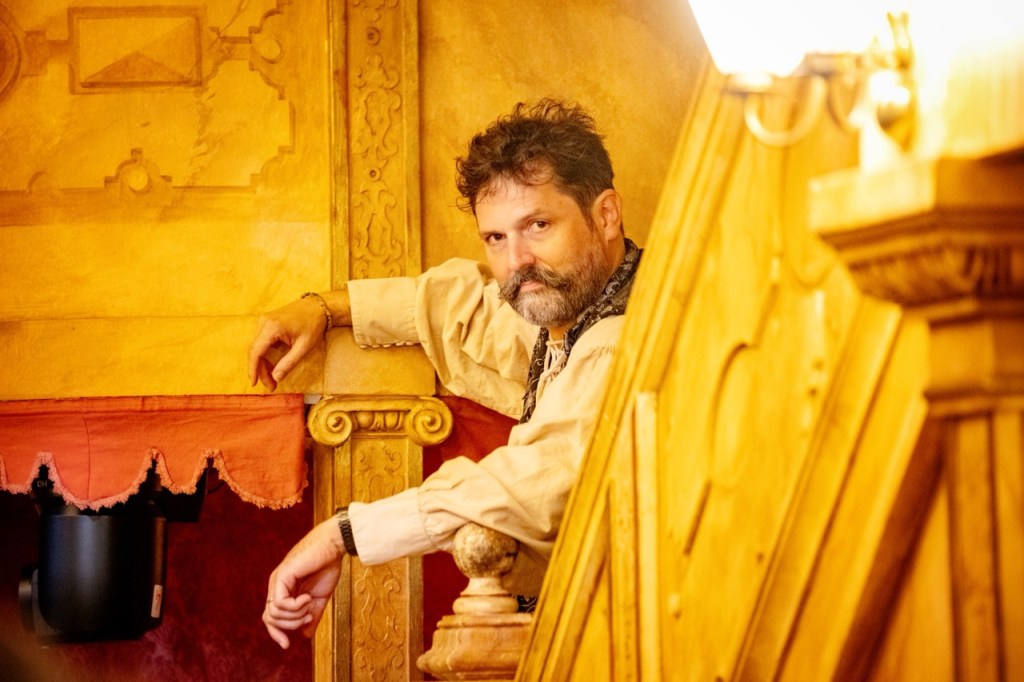
Rounding off the evening was The School of Night, who turned their attention towards improvised Shakespeare.
Beginning with something closer to Chaucerian storytelling, the trio attempted to construct a narrative through decasyllabic rhyming couplets while helping an audience member uncover the details of her ancestry in increasingly chaotic ways. While the initial set-up occasionally felt slightly cumbersome in explanation, the ambition itself remained impressive.
It was within the main body of the performance, however, that the troupe truly found its rhythm. Tasked with improvising a Shakespearean drama concerning “a unicorn in a snowstorm”, they delivered something genuinely brilliant. What emerged was not simply an imitation of Shakespeare, but a surprisingly informed engagement with the mechanics of his writing: distinctions between prose and verse and the rhythms of iambic pentameter all became part of the comedy itself.
Twenty years after its beginnings above a pub, Hoopla remains rooted in precisely the qualities that made it successful in the first place: creativity, collaboration, engagement, and an infectious sense of playfulness. More than simply celebrating an anniversary, this festival feels like a reminder of what Hoopla has spent two decades doing – nurturing performers and proving that some of the most exciting comedy emerges from stepping into the unknown.
Judging by the sheer talent on display here, the future of improvised comedy appears to be in very safe hands indeed.
Find out more about Hoopla, and get tickets to their upcoming shows here.
Image credit – Claire Bilyard
 @ALEXROYTHEATRE
Leave a comment