There is something uniquely unsettling about theatre which forces its audience into complicity. Psychological thrillers have become increasingly pervasive within contemporary theatre – I reviewed The Psychic just last week – but few productions manage to sustain tension while simultaneously interrogating the morality of both their characters and their audience quite as effectively as The Wasp. Currently playing at Southwark Playhouse Borough, this revival of Morgan Lloyd Malcolm’s dark two-hander is gripping, hilarious, and genuinely distressing.
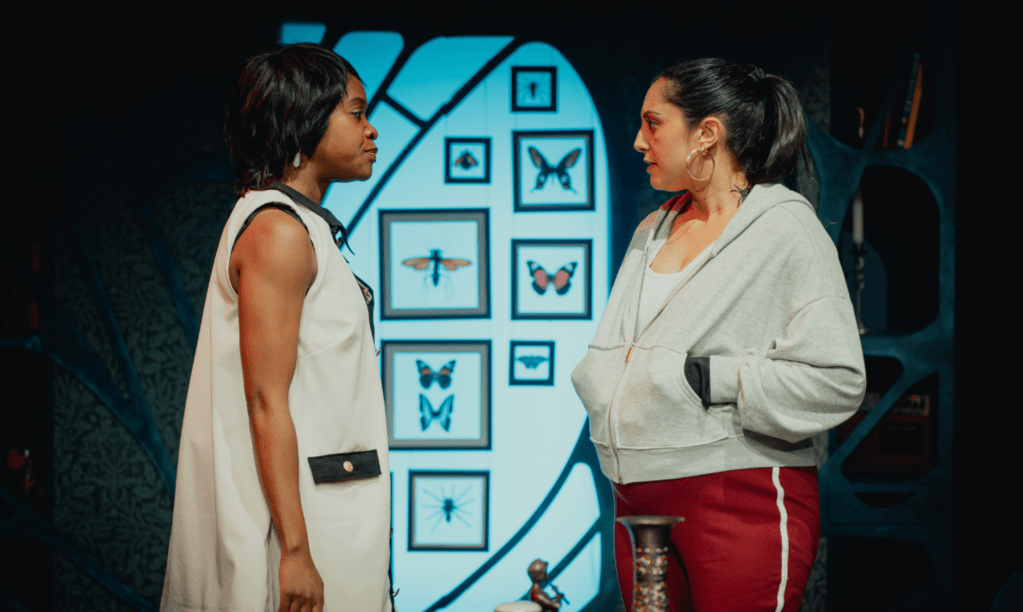
The play follows two women, Heather and Carla, who reunite years after attending school together. On the surface, their lives appear strikingly different: Carla seems polished and successful, while Heather appears trapped within a far less stable existence. Yet, as the conversation progresses, old wounds begin to resurface, buried resentments emerge, and what initially appears to be an awkward reunion rapidly spirals into something far darker and far more dangerous. What ensues is a twisting psychological thriller concerned with revenge, violence, trauma and the enduring scars of childhood.
The writing of Morgan Lloyd Malcolm is undeniably the strongest element of this production, consistently refusing to remain predictable. Lloyd Malcom has curated a script which constantly destabilises its audience, luring them into moments of humour before abruptly weaponising such laughter against them. The dialogue is razor-sharp throughout, balancing vulgar comedy with an undercurrent of evil that ensures tension never dissipates. Each revelation feels meticulously planted, with seemingly throwaway comments later returning with devastating significance. Yet, beyond the mechanics of the thriller itself, it is the emotional intelligence of the writing which proves most affecting. Beneath the twists and manipulations lies a deeply uncomfortable exploration of the enduring violence of girlhood: the way humiliation, cruelty and power imbalances from adolescence calcify within adulthood rather than disappearing from it. It is this fusion of dark comedy and emotional brutality that makes the writing so relentlessly gripping.
The strength of the writing is hindered at times by the direction of James Haddrell. While the writing is undeniably strong, the direction – particularly in Act One – forces an artistic abstraction which undercuts and undermines the poignancy of the writing, causing it to grow tiresome. The choice to utilise repetitive lines (presumably) to indicate danger, with the intermittent wasp buzzing, confuses the narrative – serving no imminent end – and undermining the poignancy of the tarantula hawk metaphor we later learn of. Its inconsistency in application, near-enough disappearing in the second act, only further highlighted this issue. It was a choice that gave the impression of distrust in the writing; a more linearly presented story would have bolstered the text immensely.
Certain elements of the direction, however, were undeniably strong – Act Two in particular. The manipulation of the set, designed by Jana Lakatos, such that certain pivotal plot moments occurred upstage made for a suffocating escalation of tension. But, the most poignant moment came in the breaking of the fourth wall in a direct address to the audience, complete with astronomically effective eye contact from Cassandra Hercules. It was a genuinely chilling moment, forcing the audience into uncomfortable self-reflection and implicating them within the moral murkiness of the narrative itself.
As Carla, Serin Ibrahim delivered a masterclass in consistent characterisation, navigating the versatile tonal demands of the piece with unfaltering ease. It was a performance that had me absolutely hooked from the outset. From the initial judgements and polished confidence, to the gradual dark unravelling of secrets and eventual collapse of composure, Ibrahim maintained absolute command of the stage. She balanced the humour and darkness of the role beautifully, ensuring Carla remained simultaneously sympathetic and deeply flawed.
Opposite her, Cassandra Hercules’ Heather proved most effective in the production’s latter half. The menacing delivery of Act Two’s darkness was terrifyingly effective, with Hercules harnessing an unpredictability that transformed the atmosphere entirely. However, the more subdued presentation required earlier in the play occasionally felt stilted, lacking the naturalism needed to fully convince in Heather’s supposed ordinariness. Still, the eventual tonal shift did much to redeem these earlier moments, retrospectively reframing the restraint as something more calculated and unsettling.
The design itself underpinned much of the production’s success. The set was simplistic yet visually striking, complete with gorgeous hanging light fixtures which lent the space a polished unease. One set change in Act One transformed the café into Heather’s home with remarkable fluidity, testament both to the direction and the performers themselves. It was genuinely one of the most satisfying set changes I have had the joy of watching: the symmetry of the design allowing the set pieces to be manoeuvred simultaneously in a way that felt almost choreographed. More importantly, it carried thematic weight. That visual symmetry perpetuated the recurring motif that, although outwardly different, these two women are perhaps not so fundamentally opposed after all, instead existing as distorted reflections of one another.
The Wasp is undoubtedly an imperfect production, but one elevated astronomically by the sheer strength of its writing and performances. Even where the directorial choices occasionally overcomplicate matters, the play itself remains gripping, funny, shocking and disquieting. It is a production which leaves its audience questioning not only the morality of its characters, but their own appetite for revenge and violence.
The Wasp is running at the Southwark Playhouse Borough until Saturday 30th May, 2026. Get your tickets here.
Image credit – Ross Kernahan.
 @ALEXROYTHEATRE
Leave a comment