It is always a joy to encounter a piece of theatre for the first time, especially when it arrives carrying the promise of unabashed silliness. Returning to the beautiful Darlington Hippodrome is equally a pleasure; there is something about the venue’s warmth which feels perfectly suited to productions of this ilk. Celebrating its 20th Anniversary Tour, Glorious! arrives with precisely that sense of theatricality, inviting audiences into the bizarre world of Florence Foster Jenkins.
The production charts the story of Jenkins, an unlikely musical sensation whose boundless enthusiasm for performance far outweighed her vocal ability. Existing in blissful ignorance towards wider realities amidst the First World War, Florence desperately pursues artistic fulfilment, recruiting a new pianist to accompany her increasingly ambitious performances. What unfolds is a story built upon delusion, devotion, and the strange magnetism of somebody utterly convinced of their own brilliance.
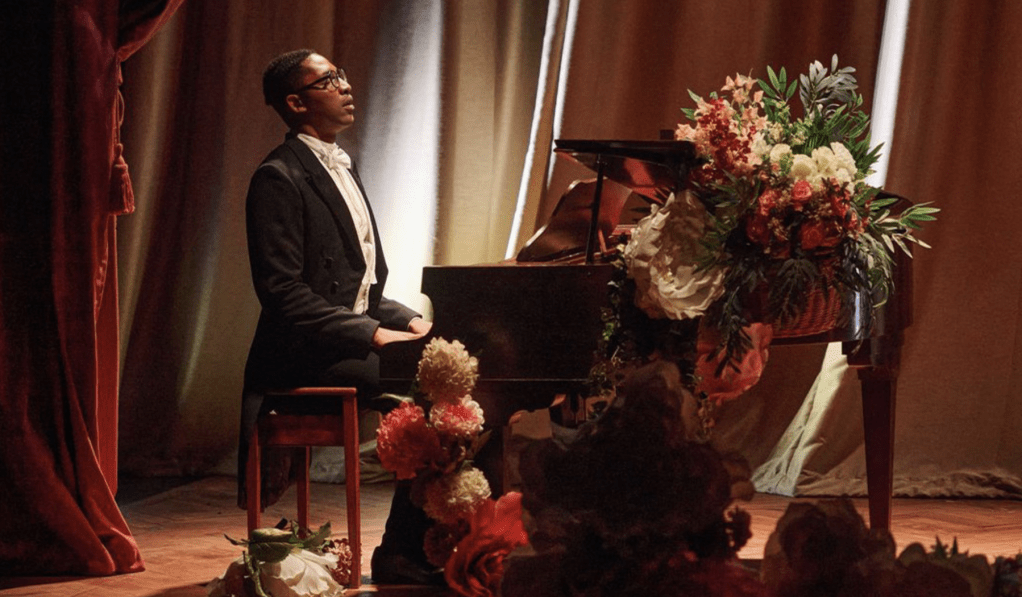
Visually, this production was a genuine feast for the eyes. Across four distinct locations – manoeuvring between Jenkins’ lavish home, the recording studio, the extravagant Ball of the Silver Skylights, and eventually Carnegie Hall – the set design consistently impressed. Each environment felt expansive and lived-in, fleshing out worlds which otherwise remain largely unspoken. Jenkins’ home was perhaps the strongest of these: floral bouquets cascaded across furniture, ornate fixtures framed the stage beautifully, and the palette of the room perfectly complemented its old-world glamour. Equally striking was the Silver Skylights sequence, whose visual excess captured the show’s eccentricity wonderfully. The production’s structural approach to scene transitions was particularly clever; given the scale of the set changes, the intermittent narration delivered in front of the curtain by Cosme McMoon disguised these pauses seamlessly, maintaining both momentum and narrative cohesion.
Regrettably, that cohesion was often hindered by the production’s relentless pursuit of comedy. The audience responded enthusiastically throughout, with laughter arriving frequently and loudly, yet the humour eventually became predictable at best and repetitive at worst. Too often, the gags arrived at the expense of emotional complexity. There are fleeting glimpses of something far more poignant beneath the surface – references to the death of Jenkins’ sister, or the handling of Florence’s own decline, which was accompanied by some of the production’s most beautiful lighting design – but these moments were never afforded the depth they deserved. The result is a production that gestures towards emotional richness without ever fully embracing it, settling instead for a succession of easy laughs.
That said, many of the production’s technical elements remained exceptionally strong. The sound design was among the evening’s greatest successes, particularly during the Silver Skylights sequence, where the atmosphere of the ballroom was rendered vividly through layered audience ambience and musical texture. It breathed life into the scene, encouraging genuine audience immersion and creating a palpable sense of occasion.
The performances further elevated the material considerably. Wendi Peters was utterly delightful as Florence Foster Jenkins, fully committing to both the absurdity and sincerity of the role. Her comedic timing was excellent, while the intentionally catastrophic vocal performance required a level of technical control that made the execution all the more impressive. Peters maintained just enough warmth to keep Florence oddly endearing throughout.
Opposite her, Matthew James Morrison delivered a vibrant and engaging Cosme McMoon. His oscillation between polished professionalism, mounting panic, camp eccentricity, and reluctant affection made for a performance which grounded much of the surrounding chaos. Morrison balanced Peters’ larger-than-life Florence with a welcome sense of competence and exasperated realism.
An unexpected standout of the evening, however, was Caroline Gruber as Maria. Her exaggerated Italian eccentricities became one of the production’s most consistently successful comedic devices, anchoring many of the show’s funniest moments with effortless confidence.
Underlying these performances was direction firmly rooted in comedy-first storytelling. The exaggerated physicality and heightened delivery certainly aligned with the production’s tonal vision, and in the opening scenes this worked effectively. However, as the evening progressed, that same exaggeration began to undercut opportunities for subtlety and poignancy. More restraint within quieter conversational moments could have injected a degree of realism that the production sorely needed, particularly given the story’s grounding in a real historical figure. Instead, authenticity often felt sacrificed in favour of amplification.
Ultimately, Glorious! succeeds as an undeniably entertaining evening at the theatre: visually lavish, energetically performed, and consistently capable of eliciting laughter. Yet beneath its camp absurdity lies the outline of a far more emotionally compelling story, one the production never quite trusts itself to explore. What remains is a fun and often hilarious theatrical experience, albeit one whose constant exaggeration prevents it from ever becoming truly affecting.
Image credit – Chris Davies
 @ALEXROYTHEATRE
Leave a comment