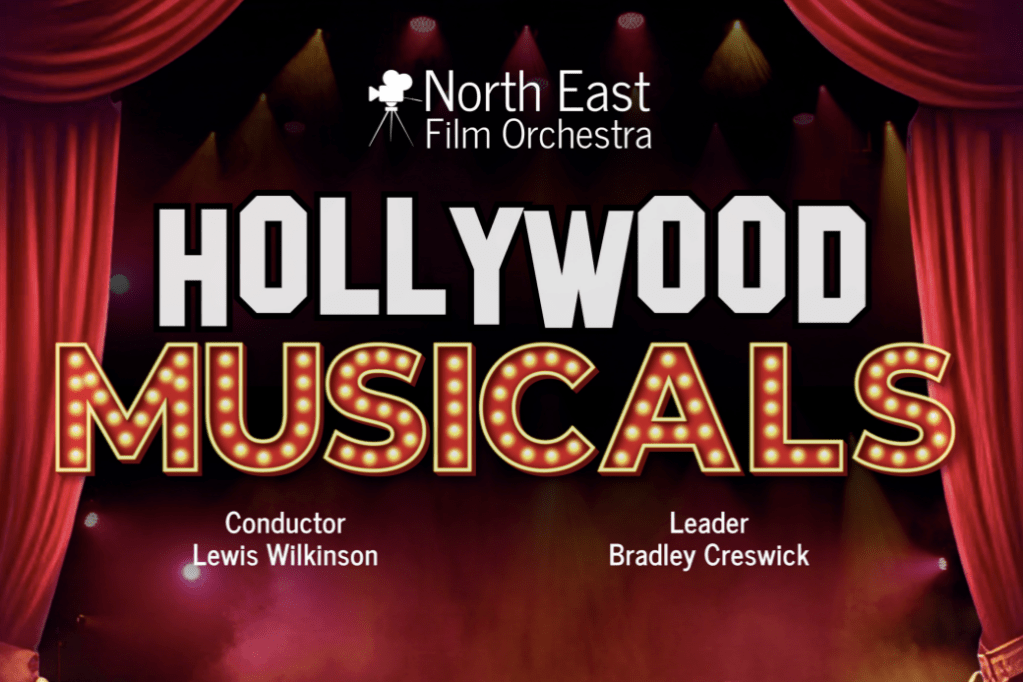
Entering the Gala Theatre in Durham is always a joy, but yesterday afternoon there was a palpable buzz in the air. From excitable pre-show chatter, to some familiar faces and seeing people with flowers clutched in their hands, there was an atmosphere that carried the promise of stagey magic. The North East Film Orchestra’s Hollywood Musicals spectacular leaned fully into this anticipation, offering a celebration of the musical movie canon.
From the outset, a mere glance at the programme proved the production intelligently crafted, moving seamlessly between eras and styles while retaining a coherence. Opening with the MGM Jubilee Overture – originally created for the 30th anniversary of Metro-Goldwyn-Mayer – we were immediately immersed in a rich tapestry of old-school Hollywood musical theatre. From Singin’ in the Rain to Over the Rainbow, this amalgamation of classic themes was a gorgeous choice, establishing both technical precision and tonal warmth from the opening beats. Immediately, it was a confident declaration of the orchestra’s ability to honour the past while bringing it vividly into the present.
The logistical structure of the show was meticulous, with a thoughtful balance struck between full orchestral numbers and those accompanied by a quartet of soloists, ensuring variety without sacrificing flow. Intermittently, we heard from conductor Lewis Wilkinson, who provided narration and insight into the pieces performed. Other numbers are allowed to speak entirely for themselves, while some were introduced by the soloists in turn. This combination was particularly effective, maintaining engagement while avoiding the risk of repetition or over-explanation. The result is a programme that felt dynamic and considered.
The selection of songs was, in many ways, genius by way of familiarity. Crowd favourites – Wicked, Les Misérables, Cats – anchored the programme, ensuring immediate audience engagement. Yet, it was not always a parade of the obvious. The decision to close Act One with Fiddler on the Roof felt especially inspired. While perhaps not the most ubiquitously revisited musical in contemporary culture, its recent award-winning revival and enduring catalogue of earworms – If I Were a Rich Man, Matchmaker – render it both accessible and invigorating, allowing it to land with charm; such charm was bolstered tenfold by the impressive musical ability of Bradley Creswick on the violin.
What truly elevated the programme, however, was its commitment to contrast. Rather than presenting a relentless sequence of high-energy showstoppers (as some might anticipate of a ‘Hollywood Musicals’ spectacular, the concert foregrounds an impressive breadth of musical and emotional range. Quieter, more introspective moments were present, allowing the orchestra to demonstrate not only power, but restraint and precision as well. This balance also enabled individual sections to shine in their own right. The closing moments of Memory, for instance, see Tom Patterson on piano/celeste and Sarah Paterson on harp emerge with a delicate, almost ethereal quality, their playing unfolding with a confidence that commanded attention.
Conversely, numbers such as Seventy-Six Trombones from The Music Man inject the programme with an infectious vibrancy, with Stuart Gray, Patrick Creagh, and Mark Howarth relishing the opportunity to step momentarily into the spotlight. Similarly, the decision to utilise the Trombones to foreground instrumental melody within the Chicago sequence – particularly during All That Jazz – was a striking one, allowing the orchestra itself to embody the theatricality so often associated with the vocals of the piece. This ensured that each performer, and each section, was afforded their moment, while still contributing to the collective fullness of sound.
Visually, the production is equally considered. Stripped of the traditional glitz and spectacle of Hollywood musicals – no set, no elaborate costumes, and no dialogue – the responsibility for visual storytelling falls largely to the lighting design by Darren Lowe. Lighting is used as a nuanced narrative device framing each piece in its familiar context: the red, white, and blue hues underscoring I Dreamed a Dream; the verdant greens evoking the woodland tension of Agony from Into the Woods; the instantly recognisable pinks and greens of Wicked’s For Good; the sultry reds that saturate Chicago. Each choice reflected a clear affection for the source material, enhancing the music while allowing the theatricality of the genre to permeate even in the absence of physical staging.
Of course, with such design elements stripped back, the orchestra bears the full responsibility of storytelling. Without the support of choreography or dialogue, the narrative burden falls to the music itself. Yet, under the assured musical direction of Lewis Wilkinson, alongside the remarkable skill of the players and the masterful orchestrations led by Alexander Proudlock, this was achieved with apparent ease. Together, they foreground the intricacies of orchestration, illuminating the emotional architecture of these familiar scores while simultaneously capturing the sheer scale of sound that underpins the magic of the musical genre.
Wilkinson’s role in shaping the performance cannot be overstated. Conducting a 68-piece orchestra is, in itself, a mammoth undertaking, yet his command of the ensemble was both precise and expressive. Remaining on his feet throughout, he navigated each transition with clarity, drawing out dynamic shifts and ensuring cohesion across sections. Maintaining tempo and shaping interpretation, there was a visible rapport between conductor and orchestra – an ease of communication that translated into a performance marked both by confidence and by unity.
It goes without saying that the orchestra itself was phenomenal. No review could truly do justice to the sheer skill, discipline, talent and artistry required to execute a programme of this scale. There is a particular challenge in performing music so deeply embedded in collective memory: the need to balance fidelity to the original with a sense of freshness. Here, the North East Film Orchestra excels. Their performances feel energetic and alive, breathing new life into familiar melodies while preserving the essence of what makes them endure.
This precision is perhaps most striking in moments of controlled silence. You’ll Be Back from Hamilton provides a perfect example: following the comically delivered “I will kill your friends and family…”, the abrupt stillness that follows lands with impeccable timing, eliciting laughter from the audience. The coordination required to achieve this – every instrument silenced in perfect unison, before resuming with equal precision – is utterly impressive. It is in these moments that the orchestra’s cohesion is most evident.
Accompanying the orchestra were four soloists – Caroline Sabiston, Jessica Brady, Glen Townsend, and Stephen Lee Hamilton – whose vocal performances added an additional layer of theatricality to the concert. Their ability to both sing and inhabit these songs ensured that the narrative dimension of musical theatre was never lost. Jessica Brady’s I Dreamed a Dream was a particular highlight, her tone rich and controlled, imbuing the piece with emotional depth. Caroline Sabiston’s rendition of Memory was equally compelling, capturing the vulnerability and power of the song in equal measure.
Glen Townsend brought a welcome comedic energy to You’ll Be Back, his performance engaging the audience to the point of audible laughter and visible delight. Meanwhile, Stephen Lee Hamilton’s Music of the Night was hauntingly beautiful, his voice carrying a palpable sense of gravitas. While there were some early issues with choppy mics – particularly during spoken introductions – these were quickly ironed out as the performance progressed, and crucially, did not detract from the strength of the vocal performances themselves.
The success of the concert was further reflected in the audience response, which played a crucial role in shaping the atmosphere of the afternoon. There was a shared sense of recognition as each piece commenced – a ripple of excitement that moved through the auditorium as familiar melodies emerged. Applause often started before a piece had fully concluded, a testament to the audience’s enthusiasm and appreciation.
This collective joy reached its peak in the encore: You Can’t Stop the Beat from Hairspray. Raising the roof in a jubilant explosion of sound, audience members clapped along, the energy in the room becoming almost tangible; it was a fitting conclusion: a reminder of the enduring vitality of musical theatre, and of its capacity to bring people together in shared joy.
Ultimately, the North East Film Orchestra’s Hollywood Musicals concert is exactly what it set out to be: a celebration. Not only of a genre, but of the music that defines it, and the communities that gather around it. In stripping back the spectacle, it allows the heart of musical theatre – the music itself – to take centre stage.
Image credit – North East Film Orchestra (producer Ellen Olley).
 @ALEXROYTHEATRE
Leave a comment