Hamlet remains one of Shakespeare’s most relentlessly revived works, this fact demanding ever-greater ingenuity from those who, once again, dare to stage it. In a theatrical landscape saturated with interpretations, the question is no longer whether to revive Hamlet, but how to justify doing so; enter Rupert Goold. As a Master’s student of English Literature – and someone who has already reviewed Hamlet once this year – I approached this production with both anticipation and excitement.
For those who know little more than “to be or not to be,” Hamlet charts the psychological and moral unravelling of the Prince of Denmark following the death of his father. When visited by the ghost of the late King, Hamlet learns that his death was no accident, but murder – committed by Hamlet’s uncle, now both King and stepfather. What follows is a study in grief, revenge, paralysis, and performance, culminating in one of the most devastating finales in the canon. Though often labelled a tragicomedy, this is a work in which tragedy ultimately consumes all, with moments of levity functioning less as relief and more as disquieting counterpoint.
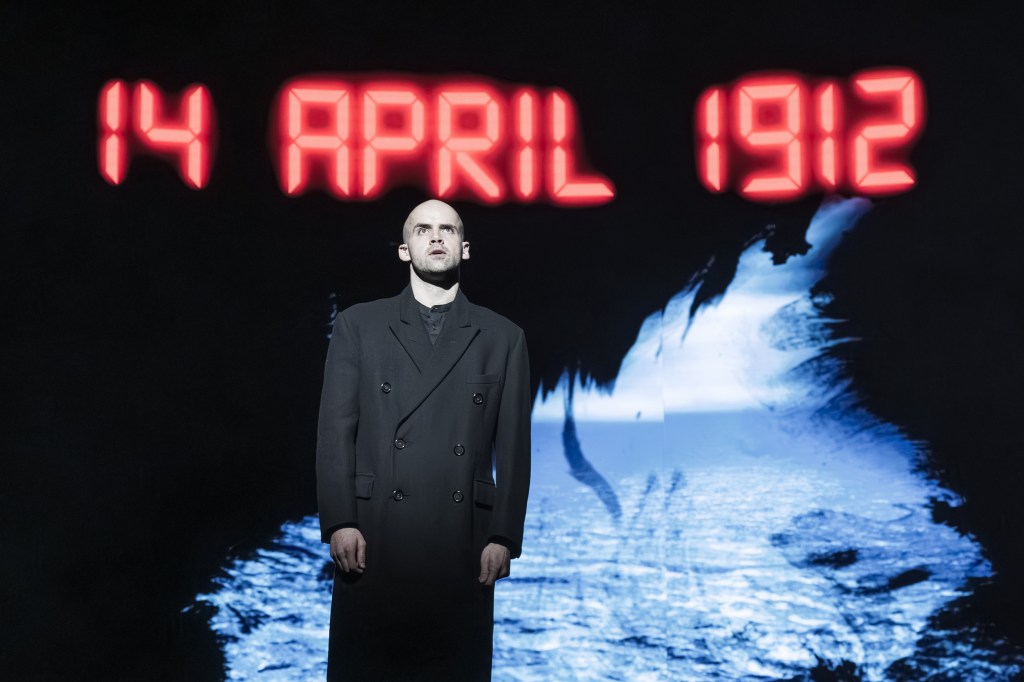
Goold’s direction situates itself firmly in the latter of two directorial traditions (such traditions recently noted by fellow critic, Mickey-Jo Boucher): not the invisible hand that allows the text to speak unmediated, but the assertive, interpretative force that reframes the text entirely. From the outset, this production declares its vision with clarity and confidence. Elsinore is no longer a castle, but a ship – an inspired relocation that transforms the play’s thematic architecture. Designed by Es Devlin, the steeply raked stage becomes a vessel perpetually on the brink of imbalance, while towering screens (with projection design by Akhila Krishnan) render the surrounding world in constant, shifting motion.
The nautical setting functions as an extended metaphor for the play’s central preoccupation with entrapment and instability. Here, the characters are not only politically and psychologically confined, but physically unable to escape – adrift within both a literal and metaphorical storm. The choreography of movement, as bodies adjust to the imagined sway of the ship, reinforces this sense of perpetual unease. The result is a production that does not simply illustrate Shakespeare’s themes, but embodies them.
Equally striking is the decision to set the production in 1912. Positioned on the cusp of modernity, this setting retains enough historical distance to preserve the play’s formal integrity, while offering sufficient familiarity to render it accessible to contemporary audiences. It is a delicate balance, but one that Goold navigates with precision: this is Hamlet neither museum-bound nor aggressively modernised, but something more fluid – an interpretation that acknowledges its own historicity while remaining theatrically immediate and thus, strikingly accessible for newcomers to Shakespeare.
The integration of projection design further exemplifies this balance. For some audience members – particularly those less accustomed to contemporary staging technologies – this may serve as an introduction to the increasing prevalence of digital scenography. Yet the production resists the common pitfall of over-reliance. In doing so, they gesture toward a broader evolution in theatrical language, one in which technology supplements, rather than supplants, live performance; as such, this production is perhaps the best introduction to the integration of video projection in theatrical set design.
Costume operates with similar intentionality. Nautical motifs subtly anchor the world, while Hamlet’s own sartorial trajectory becomes a visual corollary for his psychological descent. His shift into dishevelled, almost pyjama-like attire reads as both a stripping away of courtly artifice and a manifestation of interior collapse. Crucially, this does not feel arbitrary; rather, it signals a production in which every aesthetic choice is in dialogue with character and theme. This is a Hamlet assured in its identity.
The performances rise to meet this directorial ambition. Ralph Davis delivers a Hamlet of remarkable tonal complexity. Initially measured, his performance gradually fractures, charting a descent that is as compelling as it is unsettling. Davis navigates the interplay between grief, rage, and absurdity with precision, rendering Hamlet’s instability not as chaos, but as something disturbingly coherent. The result is a portrayal that implicates the audience in the very unpredictability the court seeks to contain.
As Polonius, Richard Cant reclaims the often-underestimated comedic dimension of the role. His acute sense of timing and self-awareness transforms Polonius from mere caricature into a figure whose humour sharpens, rather than dilutes, the surrounding tragedy. In a production so attuned to tonal modulation, this balance proves essential.
Georgia-Mae Myers offers a delicately calibrated Ophelia, her performance marked by restraint and emotional clarity. If anything, the pacing of the adapted text affords her arc slightly less space than it deserves; her descent feels somewhat compressed. Nevertheless, what is present is executed with striking sensitivity. Particularly noteworthy is Benjamin Westerby as Laertes, a role often relegated to narrative function. Westerby imbues the character with a raw, human anger that renders his trajectory both intelligible and deeply affecting.
What ultimately distinguishes this production is its cohesion. The visual language, directorial vision, and performances do not compete, but cohere – each element reinforcing the others in service of a unified interpretative framework. This is not innovation for its own sake, but innovation grounded in a clear understanding of the text’s thematic and theatrical possibilities.
Visually arresting and emotionally resonant, this Hamlet succeeds as a reimagining that justifies its own existence. In a cultural moment oversaturated with Shakespeare, that is no small achievement.
Hamlet is running at York Theatre Royal until Saturday 18th April, 2026 before continuing on its UK Tour. Get your tickets for York here.
Image credit – Marc Brenner.
 @ALEXROYTHEATRE
Leave a comment