This Easter, I have had the joy of seeing a plethora of new, exciting work across the Southwark Playhouse venues, with Lifeline standing out as one of the most highly anticipated. A staggering feat on paper, the musical attempts to juggle dual timelines while grappling with the very real and pressing global issue of antimicrobial resistance. As someone with a longstanding love of history, I am always drawn to work which stages the past in conversation with the present – and Lifeline certainly does so with ambition.
The plot unfolds across two parallel narratives. In the past, we follow Alexander Fleming in the wake of his discovery of penicillin, alongside his blossoming relationship with colleague Amalia, as they begin to confront the possibility that antibiotic resistance may undermine this groundbreaking advancement. In the present day, we meet Jess, a junior doctor navigating the pressures of modern healthcare, as she and her team confront a case of antimicrobial resistance affecting her childhood sweetheart. The interplay between these timelines is rich with potential, drawing clear parallels between discovery and consequence, hope and limitation.
Conceptually, however, this is an enormous amount to contain within a two-hour musical. Lifeline seeks to balance multiple ambitions at once: it is a love story, a narrative of personal growth, a comedic and musically engaging piece, a celebration of scientific and medical achievement, and an informative exploration of antimicrobial resistance (AMR). While admirable, this breadth ultimately raises a central question – what is the primary purpose of this show?
Where the musical falters is in its educational aim. While it repeatedly gestures towards the urgency of AMR – highlighting factors such as environmental impact and misuse of antibiotics – it stops short of offering a clear or actionable framework for understanding. As an audience member, I left feeling acutely aware of the issue’s importance, yet not significantly more equipped to engage with it beyond the familiar directive of completing a prescribed course of antibiotics. The information is present, but it often feels fragmented, lost within the momentum of the piece. Attempting to balance both education and celebration in equal measure may simply be too ambitious a task.
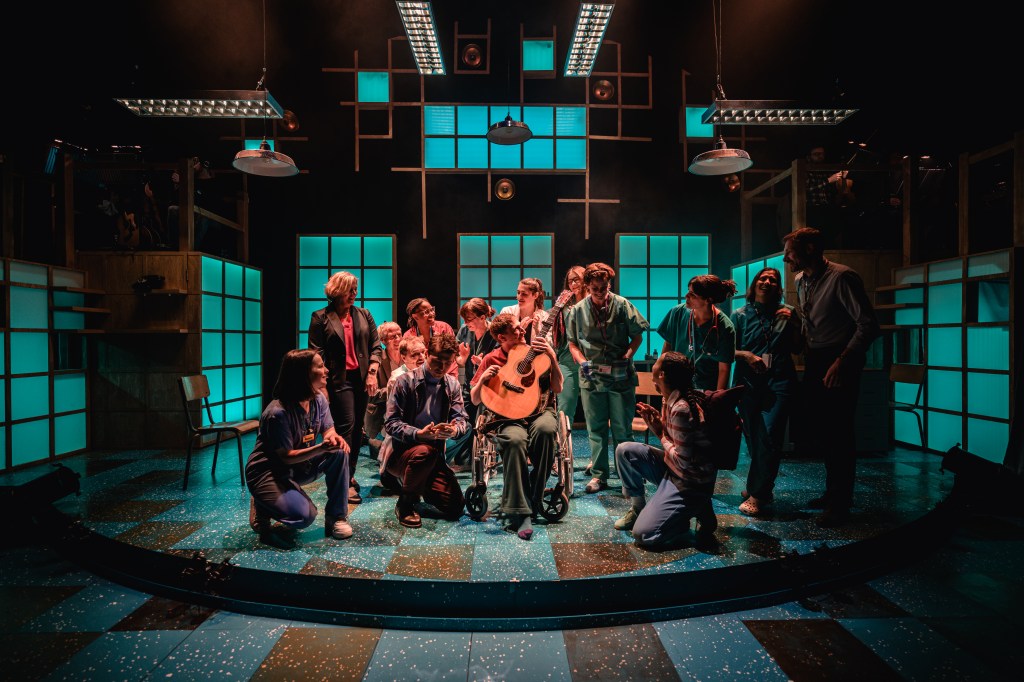
Yet, where Lifeline truly soars is in its celebration of the people behind the science. There is a prevailing sense of hope and admiration which permeates the production, rendering it one of the most unexpectedly inspiring shows I have encountered in recent memory. As someone entirely removed from the medical field, I left the theatre with profound respect for those working within it. Lead producers Robin Hiley and Jessica Conway have shaped a creative vision that foregrounds this humanity, most strikingly through their inspired casting choices. Alongside a professional cast, each performance features a rotating ensemble of real-life scientists and healthcare workers, who step into the narrative while simultaneously sharing their own stories. It is an extraordinary theatrical device – one I have not encountered before – and its impact is undeniable. The final sequences, though slightly extended, are deeply moving, grounding the musical in lived experience and bringing its central message into sharp, emotional focus.
The music itself is equally impressive. Robin Hiley’s compositions, under the musical direction of Neil Metcalfe, are nothing short of exceptional. The orchestrations are rich and varied, with inspired choices throughout – from the inclusion of bagpipes in the Scottish-set scenes, lending a folk-inflected texture, to the playful yet intricate lyricism (the rhyme of “Greek resistance” with “Welsh persistence” being a particular highlight). The score moves fluidly between tonalities, and the decision to end with an entirely a cappella passage is quietly breathtaking, allowing the voices – both of the performers and the real-life contributors – to resonate, free from external interference, with clarity and purpose.
Performance-wise, the cast delivers across the board. Alan Vicary’s Alexander Fleming is deeply affecting, capturing the scientist’s introspection, romantic vulnerability, and eventual grief with sensitivity, his vocals soaring particularly in the second act. Kelly Glyptis brings a refreshing, legit quality to Amalia, her performance both poised and expressive. Nathan Salstone offers a smooth and assured turn as Aaron/Clowes, while Max McGinglay’s Jess stands as the emotional anchor of the production – her vocal power and emotional precision marking her as a standout. Jasmine Jules Andrews also deserves particular mention for her remarkable versatility across multiple roles, navigating each with clarity and distinction.
Under the direction of Alex Howarth, the production finds much of its coherence. The handling of dual timelines is particularly impressive, with careful attention paid to visual and physical parallels – mirrored staging, repeated gestures, and echoed dialogue all working to bridge past and present. Moments of convergence are executed with precision, most notably in the seamless transformation of Clowes into Aaron, allowing both timelines to occupy the stage simultaneously in a moment of theatrical ingenuity.
This is further supported by Matthew Craigen’s lighting design, which plays a crucial role in delineating the two worlds. Fleming’s timeline is bathed in warm, almost dusty tones, evoking a sense of history, while the present-day scenes are rendered in stark, clinical lighting reminiscent of hospital environments. Smaller touches – such as the use of spotlighting reminiscent of a petri dish – add a layer of visual wit to the production’s conceptual framework that I particularly enjoyed.
Ultimately, Lifeline succeeds most powerfully as a celebration of the individuals working tirelessly across hospitals, laboratories, and beyond – those whose efforts both shape and save lives. While it does not fully realise its potential as an educational piece on antimicrobial resistance, it more than compensates through its emotional resonance and inventive theatricality. With a more clearly articulated approach to its informational aims, it could achieve a rare balance between art and advocacy. As it stands, however, it remains an ambitious, heartfelt, and deeply inspiring new musical – one that leaves its audience not only entertained, but genuinely moved.
Image credit – Charlie Flint
 @ALEXROYTHEATRE
Leave a comment