After yesterday’s venture to The Little, less than 24 hours later I found myself back at Southwark Playhouse – this time in The Large – for an immense gear shift. ThickSkin’s It Walks Around the House at Night offers a ghost story for the modern age: a psychological horror that lingers somewhere between modern comedy and unsettling thriller.
This is not a conventional ghost story. The play follows Joe, an out-of-work actor currently working in a bar, who accepts an unusual acting gig: performing as a ghost around an old manor house. As the job unfolds, Joe slowly comes to realise that his ghost is not the only one wandering the halls at night. Across five increasingly unnerving days, he attempts to complete the strange contract while confronting horrors that blur past and present, gradually unravelling the circumstances that led him to Paragon Hall in the first place.
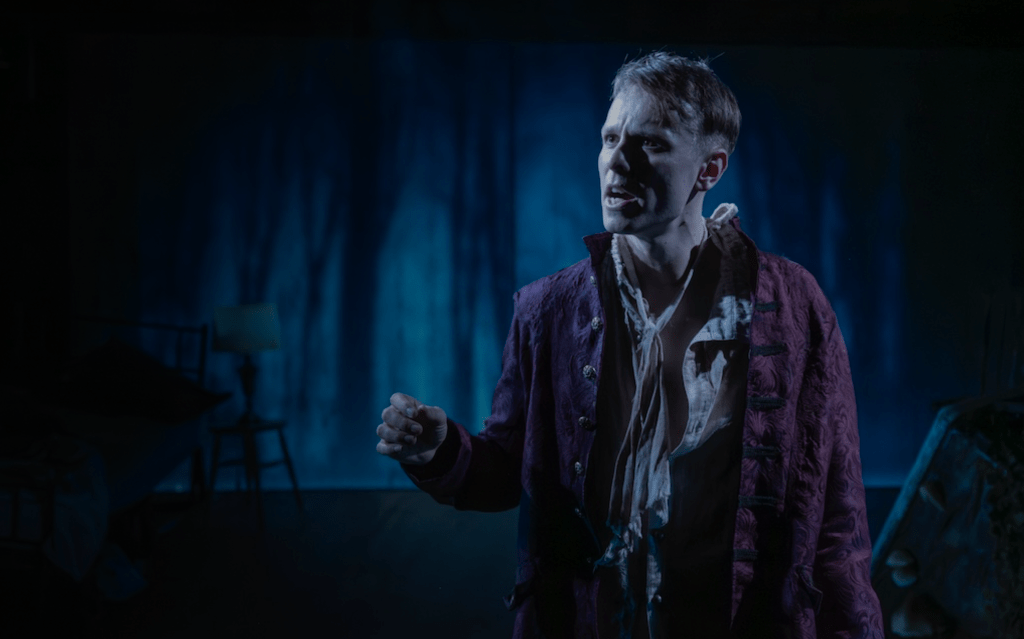
From the outset, the cohesion between lighting and sound design – by Joshua Pharo and Pete Malkin respectively – is exceptional. The technical design is nothing short of phenomenal, and easily the production’s greatest strength. Through projections mapping Joe’s nightly “walk”, the gradual animation of Paragon Hall, and subtle visual cues that guide the storytelling, the design consistently expands the world beyond the visible stage. Coupled with an evocative soundscape – from rainfall and wind to perfectly timed jump scares – the production demonstrates just how far the boundaries of a theatrical space can be stretched through design alone.
The physical set, designed by Neil Bettles and Tom Robbins, complements this beautifully. Positioned on a downward slope towards the audience, the stage is bisected upstage centre and surrounded by a textured rubber bark flooring that evokes the rawness of the setting. A bed sits upstage right while a fridge lined with greenery anchors downstage left – simple elements that nonetheless establish the world with clarity. The staging (testament to the direction of Neil Bettles) is largely consistent in its spatial logic: the nightly walk always begins from the same point, and the bedroom door remains fixed in its implied position. One brief early moment suggests Paragon Hall to be stage right before the show settles on an upstage orientation thereafter, a minor inconsistency in an otherwise meticulously realised space. More often than not, however, the interplay between direction, lighting, and sound ensures that each scare lands precisely and the storytelling remains clear. It is a genuine masterclass in technical collaboration.
Tim Foley’s writing offers a refreshingly contemporary take on the horror genre, peppered with sharply observed humour that distinguishes it from more traditional thrillers. Early quips such as the warning to “never date an actor” land particularly well among the theatre-literate audience, while recurring jokes about the dreaded “big light” – which no self-respecting gay, we are told, would ever use bring a playful campness to the script. The comedy is witty, knowing, and consistently engaging.
Narratively, the structure is particularly intriguing. The play effectively delivers two endings: the first offering immediate narrative closure, and the second – set one year later – providing a final unsettling twist that proves far more powerful. This closing moment, which directly implicates the audience, injects a sudden chill that lingers long after the lights fade. For much of the piece the retrospective framing of Joe’s story keeps the tension simmering rather than outright terrifying, but those final moments are genuinely haunting in their simplicity. At ninety minutes, the pacing remains taut throughout.
At the centre of it all is George Naylor as Joe, carrying what is essentially a ninety-minute monologue. It is a mammoth task, and one he handles with remarkable assurance. Naylor navigates the tonal shifts of the script with impressive versatility, moving seamlessly between comedy, confusion, grief, and creeping dread. His performance grounds the storytelling entirely, anchoring the audience in Joe’s psychological journey even as the world around him begins to fracture.
Alongside him, Oliver Baines appears as The Dancer – a strikingly physical presence who communicates entirely through movement. Never engaging directly with the audience in dialogue, Baines instead conveys key narrative beats through choreography, accompanied by voiceover. His fluid, unsettling movement language gives shape to the unseen horrors of the story, adding a beautifully eerie dimension to the production’s theatrical vocabulary.
Ultimately, It Walks Around the House at Night is, above all else, a technical triumph. While some elements of the writing prove stronger than others, the production’s inventive design, assured performances, and confident direction combine to create a deeply atmospheric piece of theatre.
It Walks Around the House at Night is running in The Large at Southwark Playhouse Borough until Saturday 28th March 2026. Get your tickets here.
Image credit – Tommy Ga-Ken Wan
 @ALEXROYTHEATRE
Leave a comment