The Southwark Playhouse has long been a platform for new, exciting work: bold, experimental pieces that don’t always land, but when they do, they land spectacularly. Children of the Night is one such triumph. At face value, the premise might appear niche – a portrait of 1990s Doncaster told through the lives of working-class families and the club culture that shaped them. Yet what unfolds is something far richer: a vibrant, tender, and unexpectedly moving meditation on youth, memory, and the communities that carry us through both.
From the moment we entered The Little, the tone for the evening was set. A playlist of era-defining tracks greeted the audience, culminating in The B-52s’ Love Shack, which had the room boogieing in their seats before the show started. As the music faded into a deep bassline marking the start of the play, the production’s command of sound – and its ability to use musical motifs as emotional narration – became immediately clear.
The story follows working-class teenager Lindsay (Danielle Phillips), alongside her best friend Jen (Charlotte Brown) and her father (Gareth Radcliffe), as they navigate the electric landscape of Doncaster nightlife in the 1990s. Yet the neon lights and dancefloors exist alongside far heavier realities, most notably a cluster of HIV cases among women. As Lindsay grapples with these anxieties – alongside her father’s declining health and the slow fracturing of youthful friendships – the production unfolds as a beautifully narrated, masterfully directed 90-minute play that is tonally assured and, above all else, an utter joy to watch.
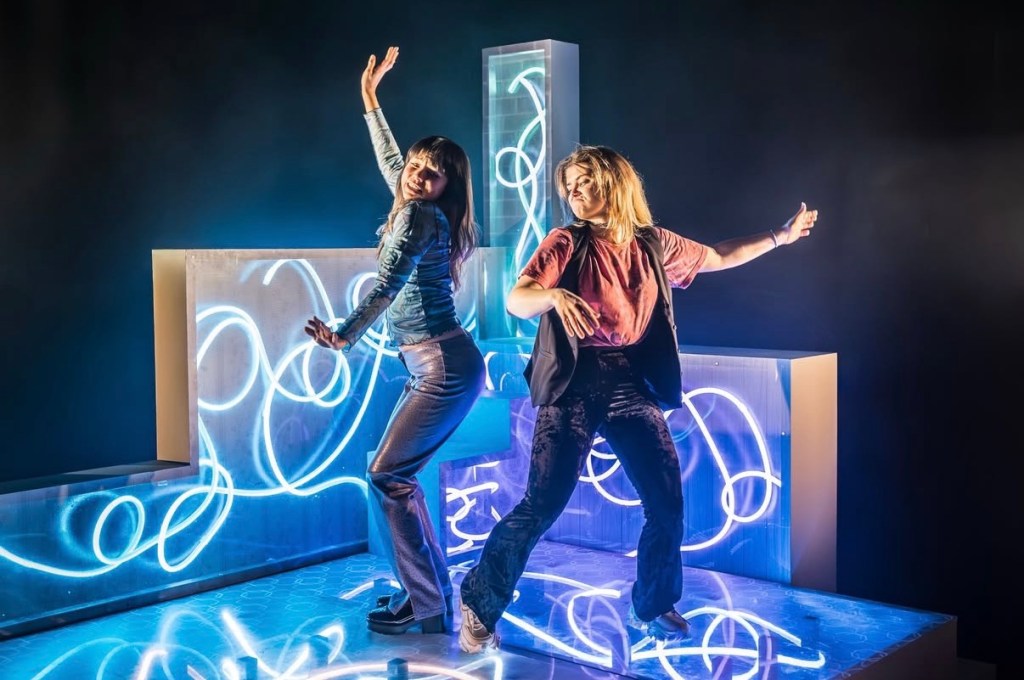
Upon entering the space, the set appears deceptively simple: a single fixed structure angled across the stage, complete with steps and ledges. But this design – by Hannah Sibai – proves nothing short of ingenious. Within moments it transforms seamlessly from Lindsay’s sitting room to her bedroom, Jen’s bedroom, a bus, Silver Street, and Karisma – the central nightclub of the story – as well as countless other locations. Each setting feels entirely distinct without requiring a single set change.
What initially seems minimal quickly reveals itself to be remarkably intricate. Entangled lights woven within the structure illuminate at key moments, subtly shaping the emotional texture of each scene. In Karisma, the lights flicker in shifting colours that evoke the pulsing energy of the club. In moments of anger, the stage is submerged in a deep red. Elsewhere, softer tones wash the space in warmth or melancholy. It is breathtakingly thoughtful design. Coupled with Jessie Addinall’s lighting design, this visual language allows the production to capture moments that might otherwise pass unnoticed: the abrupt glare of house lights flicking on at the end of a night out, or the flash of press cameras cutting through a crowd. The ability of this production to give theatrical life to such fleeting details is simply astonishing.
Equally impressive is the direction of Kimberley Sykes, whose handling of the play’s pace is masterful. Spanning more than a decade, the narrative unfolds with remarkable clarity within just ninety minutes. Entire nights out – the anticipation, the dancing, the conversations, the aftermath – are compressed into fleeting yet vivid sequences without ever feeling rushed or confusing. Particularly delightful is the repeated whistle-stop bus journey through Doncaster that precedes each night out. What could easily have become repetitive instead becomes one of the show’s most charming motifs. Small changes along the route subtly mark the passage of time – a pothole that grows larger, before eventually being filled in – gradually building a sense of familiarity with the town itself. Even for audience members who have never set foot in Doncaster, the streets begin to feel known. The people, the culture, the life – it all becomes vividly real.
Perhaps most remarkably, the world of the play is populated by dozens of characters – boyfriends, bouncers, drink buyers, members of the press; yet, the cast consists of only three performers. There is no traditional multi-roling; instead, the direction places an extraordinary level of trust in the audience, inviting us to imagine these figures into existence.
This works for two reasons. Firstly, the story is framed through Lindsay’s recollections, made clear through her intermittent radio-style narration and occasional direct address to the audience. We are constantly aware that we are witnessing memory – a collage of moments being pieced together in retrospect. Secondly, the performances themselves are so assured that the imagined world feels entirely convincing.
At the centre of it all is Danielle Phillips as Lindsay, delivering a truly remarkable performance. Across ninety minutes she navigates a striking emotional range: the euphoric highs of teenage nights out, the anxieties of growing up, the depths of grief and anger. Crucially, none of it ever feels superficial. Her performance has an extraordinary emotional clarity. For much of the play, Phillips carries what is effectively a ninety-minute monologue, shifting seamlessly between narration and lived action – addressing the audience one moment, then inhabiting the present of the story the next. It is a demanding theatrical feat, yet Phillips executes it with such ease that the transitions are never once confusing. The result is utterly mesmerising.
Opposite her, Charlotte Brown delivers a compelling performance as Jen. Initially presented as Lindsay’s slightly more anxious, slightly more innocent counterpart – beautifully reinforced through Hannah Sibai’s costuming choices – Brown captures the awkward charm of youth with precision. Her early “going-out top,” pleated skirt and patent shoes gradually give way to a denim co-ord in the second half, signalling both maturity and shifting priorities as Jen enters a more serious relationship. This visual evolution is matched by a subtle transformation in Brown’s physicality and mannerisms, resulting in a performance that feels carefully observed and deeply believable.
Meanwhile, Gareth Radcliffe’s portrayal of Lindsay’s father proves an unexpected highlight. Balancing paternal firmness with warmth and vulnerability, his performance is hilarious, tender, and quietly devastating.
What ultimately makes Children of the Night so remarkable is its tonal confidence. The production moves effortlessly between laughter and heartbreak, between nostalgia and grief. It invites its audience to laugh, to cry, to reminisce, and to learn, often within the span of a single scene.
The result is theatre at its very best: vibrant, emotionally resonant, and deeply human. By the time the lights come down, it feels as though we too have danced through Doncaster’s nights, lived alongside these characters, and carried their memories with us.
Children of the Night is running in The Little at the Southwark Playhouse Borough until Saturday 4th April, 2026. Get your tickets here.
Image credit – Marc Brenner.
 @ALEXROYTHEATRE
Leave a comment