Fringe theatre has always had a particular talent for holding humour and poignancy in the same breath. Iron Fantasy leans confidently into that tradition, offering a piece that oscillates between absurdist comedy and deeply sincere reflection. The result is a show that is frequently delightful, occasionally chaotic, but undeniably thoughtful in its exploration of what it means to be strong.
At its core, Iron Fantasy traces a journey through evolving ideas of strength. The piece begins with childhood imaginings of what strength might look like before embarking on a broader, more reflective exploration of resilience, identity, and growing up. The narrative unfolds through a tonally varied sequence of songs, anecdotes, emotional revelations, and comedic interludes – charting a path through friendships, griefs, insecurities and moments of self-discovery along the way.
One of the show’s most successful elements lies in its self-awareness. Structurally, the piece operates as a kind of meta-theatrical construction – essentially a show about writing a show. It is a format that has gained increasing traction in musical theatre in recent years (most recently with Why Am I So Single?), and one that, when executed well, can be exhilarating to watch. Here, the performers lean wholeheartedly into that conceit, frequently implicating the audience in the process of creation and gently dismantling the theatrical illusion in the process. From the opening moments – complete with playful self-narration as the performers crawl into the space – the tone is established as knowingly ridiculous yet carefully crafted.
In terms of structure, the framing of the show is perhaps its most impressive achievement. The entire piece is constructed around a cyclical exploration of strength, beginning and ending with contrasting conceptions of what that idea might mean. The opening sequence revels in the boundless imagination of childhood: being strong enough to lift Lionel Messi with one hand, to fight a gorilla, to carry the clouds, or to stand heroically against a presumed petnapper. These moments immediately establish the playful absurdity of the show’s comic language while simultaneously setting up the thematic foundation upon which the rest of the piece builds.
By the end of the show, that idea of strength has shifted dramatically. The closing reflections move towards a far more sobering understanding of resilience – one rooted in adult realities. Strength becomes something quieter and more painful: being someone’s child and no one’s parent; losing a parent; losing a pregnancy. The tonal shift is striking, and genuinely moving. In this sense, the cyclical structure provides a deeply satisfying framework for the show’s central themes, bringing its emotional arc to a poignant and reflective close.
While this overarching structure is beautifully executed, the journey between those two points occasionally feels somewhat uneven. The central sections of the show can at times veer towards incoherence, with tonal shifts that feel less deliberately constructed than the opening and closing moments might suggest. The oscillation between comedy and emotional depth – while often effective – sometimes undercuts the impact of both. Moments of sincerity are occasionally interrupted before they have the space to land, while certain comedic sequences appear almost tangential to the narrative trajectory.
Similarly, the show’s recurring references to Xena: Warrior Princess did not entirely land for me. While the autobiographical significance of this framing device is clear, much of the humour relies on a familiarity with the cultural reference that may not be universally shared. For audiences less acquainted with the series, some of these moments feel slightly distanced from the central narrative. The emotional intent remains evident, but the reference point itself does not always resonate with equal force.
That said, the comedy throughout the piece is often genuinely excellent. Much of the show’s humour comes through its playful engagement with music – Iron Fantasy operating, in many ways, as a parody musical of sorts. One particularly memorable moment sees a song about the body parody Shakira’s “Whenever, Wherever,” a concept that proves as ingenious as it is hilarious in execution. Another riff on Christina Aguilera’s “Fighter” lands equally well, demonstrating the show’s ability to merge pop culture references with sharp comedic instincts.
Importantly, the musical elements are not purely satirical. As the show progresses – particularly in its latter stages – moments of genuine vocal beauty begin to emerge. Beneath the parody lies a surprising musicality, with several passages showcasing the performers’ impressive vocal abilities and lending an unexpected sincerity to the material.
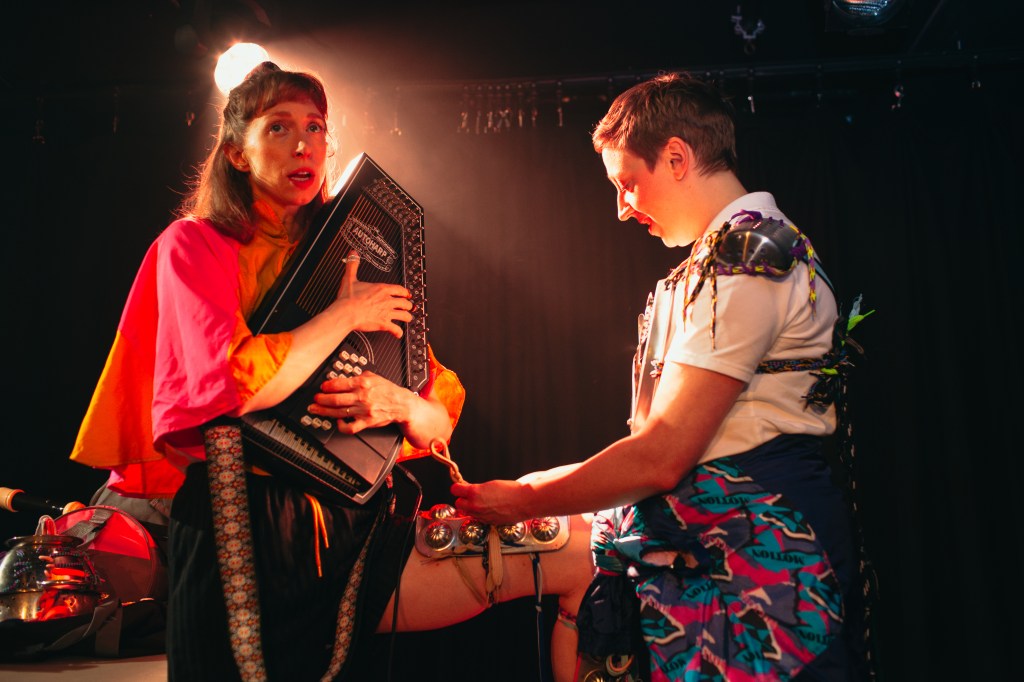
Perhaps the most inventive comedic moments, however, arise from the show’s imaginative use of props. Instruments, items of clothing, and – most memorably – a raw egg are deployed with remarkable ingenuity, creating moments of visual absurdity that consistently provoke laughter. Yet these props are not merely gimmicks. In several instances they are used to deepen the thematic texture of the piece. One particularly striking moment sees the microphone cord repurposed to evoke the familiar gesture of holding keys between one’s fingers while walking home at night – a simple yet powerful image that speaks directly to the lived experiences of many women. It is in moments like these that the show’s playful creativity finds genuine emotional resonance.
Both performers bring tremendous confidence and clarity to the stage. Shamira Turner delivers a particularly compelling performance, navigating the show’s emotional terrain with impressive ease. Her portrayal deftly captures the harsher familial realities woven into the narrative while maintaining a sharp comedic instinct. Turner’s improvisational ability is especially impressive, lending several moments an exhilarating sense of spontaneity, most notably in filling unexpected silences or off-setting mishaps.
Eugénie Pastor, meanwhile, offers a performance of striking tonal range. She moves fluidly between comedic exuberance and moments of profound emotional sincerity, allowing the show’s more reflective passages to land with genuine impact. Her performance is at once moving and delightfully absurd – an impressive balance to maintain within such an unpredictable piece.
Together, Turner and Pastor form a wonderfully engaging partnership both in their writing and performing. Their dynamic captures the chaotic intimacy of female friendship with warmth and authenticity, balancing silliness with sincerity in a way that anchors the show even in its most unpredictable moments.
Iron Fantasy is not without its imperfections. At times, the show’s own chaotic energy threatens to overwhelm the coherence of its narrative. Yet even in those moments, the creativity, humour and emotional honesty of the performers remain compelling. What emerges is a piece that may occasionally lose its way, but never its heart.
Ultimately, Iron Fantasy is a joyful and inventive exploration of strength, friendship and self-discovery. It may be messy at times – but like the journey of growing up itself, that chaos is very much part of the point.
Iron Fantasy is running at Soho Theatre until Saturday 21st March, 2026. Get your tickets here.
Image credit – James Allan
 @ALEXROYTHEATRE
Leave a comment