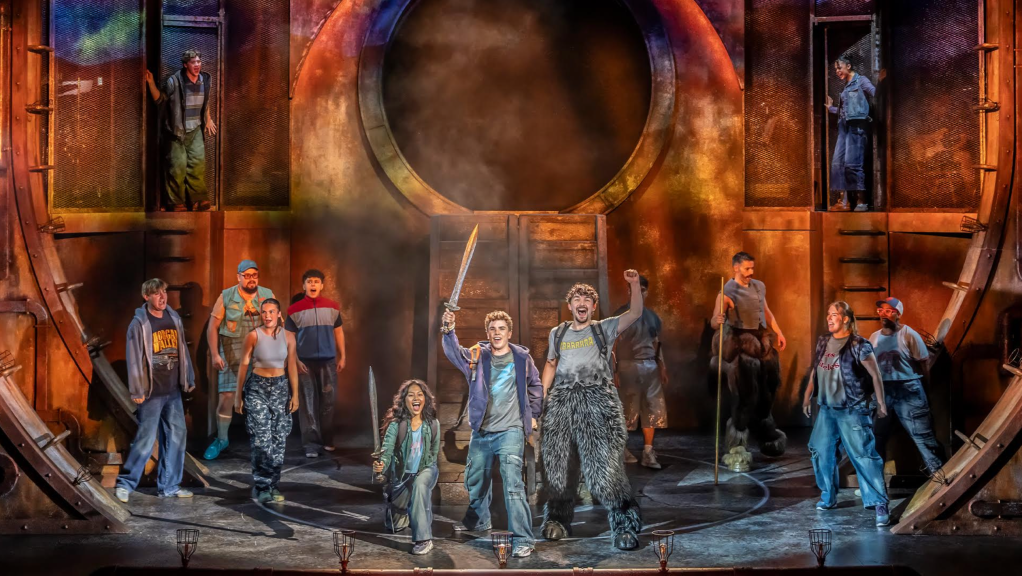
Watch out, mortals… this week The Lightning Thief: The Percy Jackson Musical has landed at the Darlington Hippodrome, promising magic, menace, and a score packed with irresistibly catchy songs. Having unfortunately missed the show’s run at The Other Palace last year, I was thrilled to head to the Hippodrome to indulge in an evening of mythological mayhem.
For those unfamiliar with the chaotic universe of Percy Jackson (as I largely was upon entering the theatre), the musical adapts the first of Rick Riordan’s seven books: The Lightning Thief. The story follows twelve-year-old Perseus Jackson, who discovers that he is a “half-blood” – the son of a Greek god and a mortal woman, not to be confused with the half-bloods of the Wizarding World. Following a devastating turn of events involving his mother, Percy is taken to Camp Half-Blood, a training ground for demigods. There he discovers that his father is Poseidon, one of the formidable “Big Three” gods. Before long, Percy finds himself at the centre of a mythic mystery: Zeus’ lightning bolt has been stolen, and Percy is suspected. In order to clear his name and prevent divine catastrophe, he embarks on a quest across the United States with Annabeth and Grover, encountering the likes of Medusa, Ares and Hades along the way. As with any great hero’s journey, the quest brings danger, discovery, and the tentative blossoming of friendship.
Bringing such an expansive mythological world to the stage is no small undertaking. Impressively, the production achieves this primarily through design – particularly the seamless interplay between set and projection. Ryan Dawson Laight’s deceptively simple yet highly adaptable set allows the story to move fluidly between locations, while Matt Powell’s projection design enhances each setting with remarkable clarity. Whether transporting us to a museum, situating us beside the ocean, or evoking movement during numbers such as Drive, the video design is a masterclass in restraint: always enriching the world of the show without ever overwhelming it.
Costume design – also by Dawson Laight – proves equally inventive. The gods in particular are characterised through costumes that balance theatrical gimmick with thoughtful detail. Hades’ glittering ensemble is gloriously flamboyant, while Ares’ leather-clad biker aesthetic proves hilariously apt. Yet the standout was undoubtedly Danny Beard’s Mr. D, whose dazzling suit – punctuated by vibrant neon flourishes – perfectly captures the character’s irreverence.
Elsewhere, the physical design of mythical creatures demonstrates real ingenuity. Cahir O’Neill’s Grover boasts impressively realised goat legs, while Niall Sheehy’s Mr Brunner makes clever use of exaggerated centaur legs (admittedly only two are visible rather than the expected four); the illusion is remarkably effective, offering a playful theatrical solution to an otherwise complex challenge.
Magic, too, plays a significant role in bringing this world to life. The show’s illusions are genuinely astonishing: a character appearing in two places at once through clever use of stunt doubles, flying shoes seemingly defying gravity, and a pen that transforms effortlessly into a sword. These moments feel utterly magical.
Equally delightful, if less technically complex, are smaller touches that heighten the show’s sense of wonder. The use of bubbles, for instance, proves unexpectedly charming – whether used for comedic effect in the infamous “toilet” scene or to evoke a barrage of water. It is a small detail, but one that contributes to the show’s whimsical spectacle.
My primary reservation with this production, however, lies in its tonal uncertainty. At times, the show seems poised to offer a sincere retelling of Percy Jackson’s journey – one that taps into the emotional and mythological richness of the source material. Moments such as Percy’s reflections on his mother, or the more introspective character ballads, hint at genuine emotional depth. Yet, these moments are frequently undercut by sudden shifts into exaggerated caricature. The production oscillates between earnest storytelling and overt satire without ever quite deciding which mode it wishes to inhabit. As a result, emotional stakes often dissipate before they are allowed to fully land.
Where this comedic approach works – particularly in the character of Mr. D – it works exceptionally well. Danny Beard embraces the role’s irreverent absurdity with infectious confidence, making the god’s sardonic presence one of the production’s most consistently enjoyable elements. Crucially, Mr. D exists largely on the periphery of the narrative, meaning that his satire enhances rather than disrupts the story. When similar humour is applied to characters who carry greater narrative weight, however – most notably Poseidon – the effect feels strangely underwhelming. A figure whose arrival should carry immense emotional significance instead lands with surprising levity, diminishing what ought to be a pivotal moment.
Lizzi Gee’s direction occasionally reflects this same tonal ambiguity. Visually, the staging is dynamic and imaginative, making excellent use of the stage’s physical space. The camaraderie between Percy, Annabeth and Grover in particular is vividly realised, lending the trio a buoyant sense of youthful energy. Yet the broader tonal identity of the production remains somewhat elusive, as though the show is still deciding precisely what kind of story it wishes to tell.
That said, the performances themselves are consistently strong. Vasco Emauz leads the cast with an engaging portrayal of Percy Jackson, capturing both the character’s restless teenage energy and the dawning weight of heroic responsibility. His performance moves convincingly between humour, vulnerability, and moments of quiet introspection, supported by impressive vocal strength.
Alongside him, Kayna Montecillo delivers a grounded and compelling Annabeth, serving as a steady anchor within the trio while offering some of the evening’s most powerful vocals. Cahir O’Neill’s Grover provides many of the production’s most effective comedic moments, his physicality and timing proving particularly delightful.
The ensemble likewise deserves considerable praise. Lizzi Gee’s choreography is energetic and inventive, executed with admirable precision and enthusiasm by the company. In truth, I occasionally found myself wishing there were more opportunities for the ensemble to showcase it.
Danny Beard is a comedic powerhouse, navigating audience interaction with effortless confidence, while Niall Sheehy demonstrates remarkable versatility as Mr Brunner and several of the Greek gods. Simone Robinson also undertakes an impressively wide range of roles across the production. While her portrayal of Sally Jackson feels somewhat restrained, her performance as Charon – particularly during the formidable DOA – is electrifying and undoubtedly her standout moment of the evening.
Ultimately, while The Lightning Thief occasionally struggles to balance sincerity with satire, it remains a production brimming with energy, invention, and undeniable joy. At its best, the show captures the chaotic thrill of youthful adventure, delivering moments of genuine spectacle alongside an infectious sense of fun. If its tonal compass were slightly steadier, this demigod adventure might truly strike like lightning. As it stands, it remains an exuberant – and frequently delightful – theatrical quest.
The Lightning Thief is running at the Darlington Hippodrome until Saturday 14 March, 2026. get your tickets here.
Image credit – Johan Persson
 @ALEXROYTHEATRE
Leave a comment