Last night, I had the absolute joy of returning to one of my favourite theatres, York Theatre Royal, for the opening night of Phoenix Dance Theatre’s Spring 2026 Touring show, Interplay. As someone whose stagey life was first ignited by dance, stepping back into the world of dance always feels like coming home – to something instinctive, wordless, and deeply human. By the bows, I had grinned, laughed, cried and cheered. Interplay is not merely an evening of exceptional dance; it is a celebration of connection – of what binds us together when language falls short.
Reviewing dance is, for me, categorically more difficult than reviewing text-based theatre largely because I am so completely transfixed. There is no dialogue to dissect, no libretto to quote; only the body, breath and space to absorb. Interplay, a mixed bill of four distinct works, explores duality through duet and ensemble pieces alike. Across the evening, contrasting perspectives converge in a shared physical vocabulary, celebrating collaboration both in the construction of the choreography, its execution, and its audience reception. The result is a programme that feels at once meticulously crafted and gloriously alive.
The evening opened with Next of Kin, choreographed by Marcus Jarrell Willis and performed by Dylan Springer and Dorna Ashory. Set to Bach’s ‘Violin Sonata No. 2 in A Minor, BWV 1003: II. Fuga’, the piece immediately established the theme of duality, and set the bar impeccably high. What struck me most was the musicality: Jarrell Willis’ choreography feels sculpted from the score itself, rather than imposed upon it. Movement did not sit on the music, but breathed with it. The effect was quietly breathtaking.
Springer and Ashory danced with a synchronicity that felt almost telepathic; it was playful yet precise, and tender yet technically fearless. Melissa Parry’s vibrant costumes consisted of bold shirts, shorts and socks, and introduced a childlike joy that softened the classical structure of the music. It was a piece that shimmered with intimacy and trust.
The tonal shift into Ed Myhill’s Why Are People Clapping?!, restaged by Camille Giraudeau, was electrifying. Drawing on Steve Reich’s Clapping Music, yet often unfolding in silence, this piece foregrounded the body as instrument. Here, rhythm was portrayed as the genesis of life itself. The performers created percussive soundscapes with their own hands, transforming applause into art.
The brilliance of this work lies in its joyful curiosity – its recognition that dance is everywhere. In the buzz of an insect, the bounce of a tennis match, and even the absurdity of a pulled face; such was dynamic and disarmingly inventive. Jose Tevar’s original lighting design, reimagined by Luke Haywood, framed the stage with warm strung lights, while crisp white illumination ensured that every flicker of expression was visible.
Act One closed with Small Talk, choreographed by James Pett and Travis Clausen-Knight – another collaborative pairing reinforcing the ethos of Interplay – was an unflinching portrait of love in flux. Performed by Aaron Chaplin and Hannah McGlashon, this extended duet unfolded against the simplest of domestic settings: a chair, a lamp, a rug. Set to ‘Preludio Op. 28 No. 4 – “The Pain Room” (Re-Recorded Version)’, ‘String Quartet No. 14 in D minor, D. 810 “Death and the Maiden” (Quatuor Arod)’, and ‘Spiegel im Spiegel’, it centred emotional volatility with devastating clarity.
Through exquisite partner work and an aching manipulation of stillness, Chaplin and McGlashon charted the fragile terrain between holding on and letting go. The choreography oscillated between embrace and recoil, and comfort and rupture. Stillness, here, was as communicative as motion. Alina Longmore’s understated lighting design and Janne Beresford’s costume design ensured nothing distracted from the emotional epicentre of the piece. It was profoundly human in its recognisable portrayal of emotion, and quietly shattering in its audience reception.
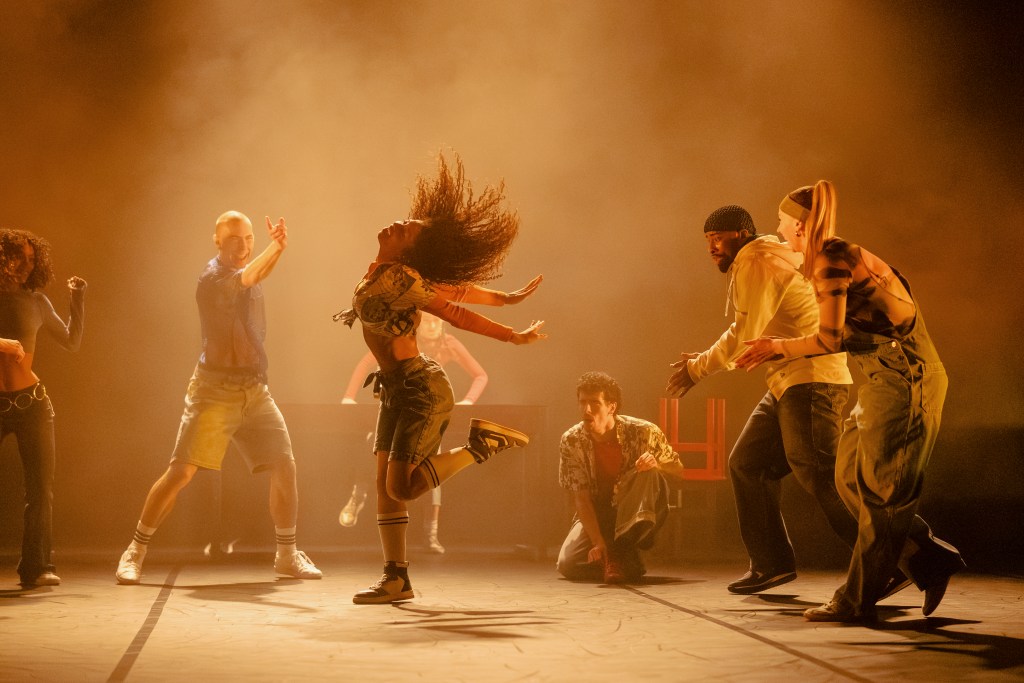
Act Two marked a gear shift, returning to Marcus Jarrell Willis – now collaborating with Yusha-Marie Sorzano – for an extended contemporary ensemble work called Suite Release that revelled in the instinctive nature of movement, showcasing its unity and joy. Where Small Talk lingered in fracture, this piece pulsed with collective release. For the first time, lyrics were implicated, with moments of lip-sync interwoven into the choreography, further grounding the work in lived experience.
As a trained Ballroom and Latin dancer, I was utterly delighted by a samba-esque sequence that rippled through the stage with an effervescent energy. Luke Haywood’s lighting design came into its own here, with blue, pink and purple hues bathing the performers in a celebratory vibrancy. Wherever I looked, there was something alive: a lift suspended in trust, some solo movement charged with defiance, or an ensemble moment bursting with shared rhythm.
Jarrell Willis and Sorzano’s choreography does something rare – it makes you feel every peak and trough viscerally. The transitions from fluid lyricism to high-energy, almost commercial contemporary were seamless. It was exhilarating.
Of course, none of this would resonate without the phenomenal calibre of the dancers themselves. Their technical precision is a given; what elevates this company is the unmistakable presence of self. Nothing felt overly prescriptive, with each performer inhabiting the work with individuality and emotional transparency. They were not simply executing choreography but offering themselves in a way which facilitated effective engagement with the audience. The stamina alone was staggering: from quiet, low-energy fluidity to explosive, full-bodied sequences that demanded everything. Yet, even at their most volatile, the connection never wavered – neither between dancer and dancer, nor between stage and audience.
That, ultimately, is the triumph of Interplay. It reminds us that dance is not mere technical abstraction; it is communication in its purest form. It is collaboration made visible. It is an expression of humanity, connection, and a reminder of why we move at all.
I urge you to run to catch Interplay on its Spring 2026 Tour. Find more information, and get your tickets here.
Image credit – Drew Forsyth
 @ALEXROYTHEATRE
Leave a comment