Few theatrical devices are as powerful – or as dangerous – as nostalgia. In its 40th anniversary performance and subsequent tour, That’ll Be The Day wields it generously, inviting audiences to relive the soundtrack of their youth through an exuberant sequence of tribute performances. Yet this retrospective gaze proves double-edged: while the music delights, the production’s comedic framework reveals a resistance to progress, exposing a show more invested in preserving the past than advancing beyond it.
First staged in 1986, That’ll Be The Day began life as a modest three-week tour. Forty years and over 6,000 performances later, its premise remains simple and, on paper, enticing: a whistle-stop tour through popular music from 1955 to the 1980s, featuring tribute performances to a range of iconic artists across genres. Musically, this remains the show’s strongest asset, with the audience responding warmly to the parade of familiar hits, testament to the creative vision of producer and director Trevor Payne. Interspersed throughout, however, are scripted comedy sketches, and it is here that the production most consistently falters.
At its best, the show thrives on the collective enjoyment of music. The pleasure of hearing well-known songs performed with confidence is met by clapping, singing, and gentle dancing in seats. Nowhere was this more evident than in Nikki-Renee Hechavarria’s rendition of Tina Turner’s Simply the Best, a genuine crowd-pleaser and the undeniable vocal highlight of the evening. Moments such as this which foreground vocal tenacity and audience participation remain the most memorable. Rock Around the Clock proved an effective opening number, immediately energising the auditorium, while a playful reworking of Jukebox Jury encouraged spectators to declare songs “hits” or “misses” through applause. These sequences leaned successfully into the nostalgic contract the production offers.
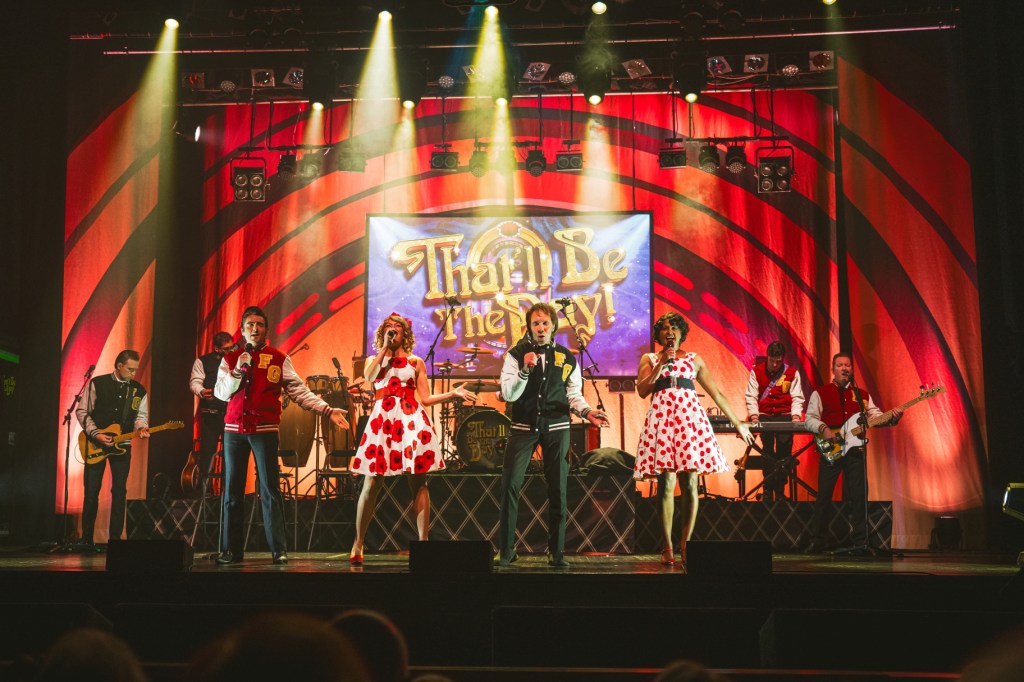
The use of a sole projector screen also contributed positively, inadvertently enhancing the nostalgia of the evening. For a one-night anniversary performance, they worked effectively to supplement the narrative between musical eras. An opening “rewind” sequence drew the audience from the present day back to 1955 through a montage of songs, television advertisements, royal events and pop-cultural moments, establishing both context and tone. This visual language continued throughout the show, reaching its most striking expression at the close of Act One with All You Need Is Love, set against a psychedelic, geometric digital backdrop. The management of this technology was smooth and assured, reflecting the work of production manager Mike Stevens and monitor sound engineer Ash Lawson.
Technically, the lighting design deserves particular praise. James Redford’s work was consistently responsive to musical mood, from the opening beats to the final curtain. The pink, purple and blue hues accompanying All You Need Is Love, paired with bubbles drifting over the stalls, created an undeniably enchanting tableau. Similarly, the pink hues accompanying Gary Anderson’s I Can’t Help Falling in Love With You produced one of the evening’s most visually affecting moments.
Yet despite these technical triumphs, the production stumbles badly in its comedic ambitions. Marketed as an integration of music and comedy, it is the music which carries the show; the humour frequently misfires. Sketches ranged from school-room pastiche to a grotesque parody advertisement, some of which drew adequate laughter from sections of the audience. One sequence, however, was deeply troubling. Trevor Payne, performing not as a character but seemingly as himself, reminisced about the “good old days” before launching into a routine mocking contemporary queer education. A line referring to “bees that want to be birds but still have stingers” was delivered as a punchline, eliciting concerning laughter from parts of the stalls.
This moment crossed from outdated humour into something actively harmful. To stage such material in the current political climate – and during LGBTQ+ History Month – is not merely tone-deaf but fundamentally regressive. Although prefaced with a casual “do what you want; I don’t care,” the joke relied upon transphobic and homophobic presuppositions, and its delivery suggested genuine sentiment rather than satirical distance.
It is here that the broader difficulty of the production becomes clear. The show relies heavily on what might best be described as weaponised nostalgia, using cultural familiarity as a shield for material that feels dated at best and offensive at worst. Rather than functioning as a playful homage to musical history, it increasingly resembles an ode to itself: a production born in the twentieth century that appears determined to remain there. Though it boasts regular updates and guest performers (on this occasion, Tom Ball), its core sensibility remains stubbornly fixed.
Perhaps Trevor Payne’s imminent farewell may allow space for genuine reinvention. With fresh leadership, the concept could evolve into something celebratory rather than defensive — an ode to the past rather than a refusal to move beyond it.
The anniversary performance also suffered from an excessive running time, stretching to three and a half hours. While additional numbers and guest appearances are understandable for such a milestone, greater editorial restraint would have benefitted the pacing. Strategic cuts or mash-ups might have preserved momentum without exhausting goodwill. It is never a great sign when audience members are forced to pour out of the venue in their dozens before the finale!
Vocally, however, the cast cannot be faulted. Payne and Gary Anderson displayed clear dedication to the material, while Hechavarria, Lotty Anderson and Jodie Lawson offered some of the strongest performances of the evening, embodying a range of iconic female artists with impressive versatility. Ollie Gray’s musicianship also stood out, particularly in the touching acknowledgment of his long association with the show. The band in particular deserve boundless praise – this musical marathon is no easy feat, and they attacked its demands with verve, rigour and enthusiasm throughout.
The evening was supported by Make-A-Wish, and a late-show number performed by the sensational vocalist Tom Ball alongside children connected to the charity proved genuinely moving, offering a rare moment of emotional sincerity amid the spectacle.
Ultimately, That’ll Be The Day, at least in this iteration, offers an evening of familiar songs that will appeal to audiences who enjoy tribute acts and unchallenged nostalgia. Yet its reliance on offensively dated humour, coupled with its unwieldy length, undermines what might otherwise be a celebratory musical retrospective. With a shorter running time and a re-imagined approach to comedy, its central concept could yet justify another forty years on the road.
Image credit – Jessie Hawkes
 @ALEXROYTHEATRE
Leave a comment