Amidst the seasonal barrage of festive pantomimes, it is something of a relief to encounter a piece of theatre that refuses to don a Santa hat and fairy wings. Bag of Beard’s The Highgate Vampire, currently haunting the Omnibus Theatre in Clapham, offers an evening of satirical horror-comedy that is gleefully irreverent, knowingly silly, and, at its strongest moments, genuinely unsettling (in a good way, I promise).
This production also marked my first venture into the Omnibus Theatre – a building I have walked past near-weekly without actually ever venturing inside – and it proved a fitting setting for a show so invested in atmospheric intimacy. Written and performed by James Demaine and Alexander Knott, The Highgate Vampire frames itself as a lecture delivered under the auspices of the delightfully absurd C.L.O.A.K.: the Centre for the Location of the Occult and Arcane Knowledge. From the outset, the audience are dubbed attendees, inducted into a scholarly investigation of a mysterious entity referred to only as the “v-word”, hilariously described as “rhyming with campfire”.
This conceit immediately established the tone: gloriously pompous, yet never taking itself too seriously. The “lecture” is initially delivered primarily by Sheffield (Alexander Knott), a demon-hunting Catholic Bishop whose confidence far outweighs his credibility. Alongside him is Farringdon (James Demaine), a shaman who stands in stark opposition to Sheffield’s dogmatic certainty. Through a series of character vignettes – including the hilarious Mrs Battersby, the shaken Lisa, and a memorably Cornish man and his dog – the audience is guided through alleged sightings of the Highgate Vampire, jumping throughout time as the story unravels and doubts begin to emerge. Eventually, the narrative converges on Highgate Cemetery itself, where memories of grave-digging and man-made horrors bleed into something darker.
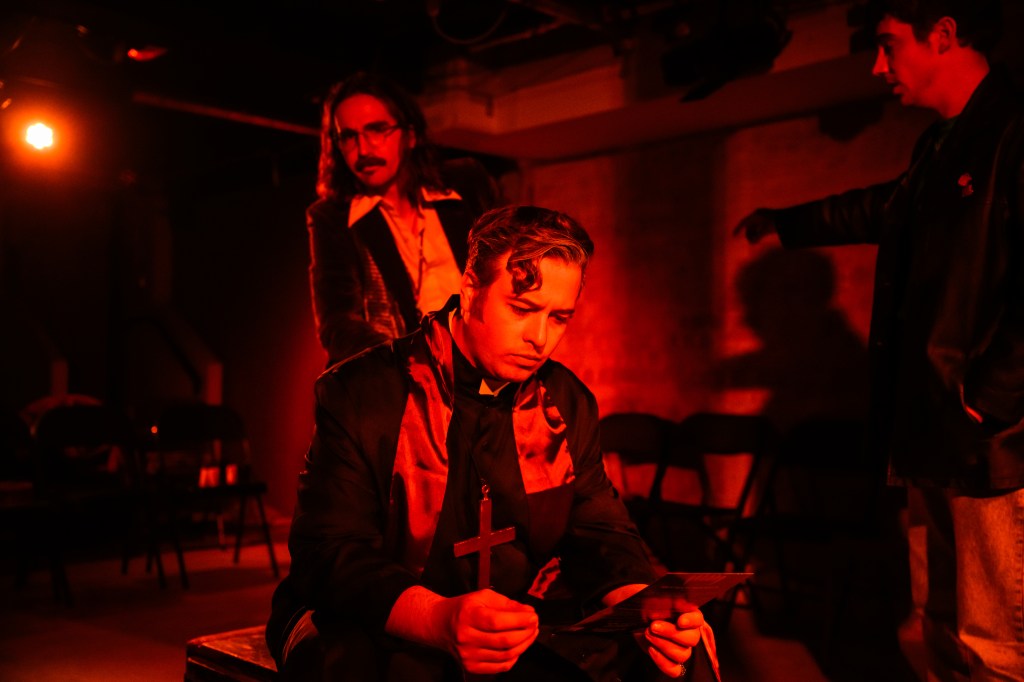
This production is particularly successful in is its handling of spookiness. Jump-scares are deployed with confidence and restraint, never overwhelming the comedy but consistently unsettling. From the moment the audience entered the space, we were immersed in eerie, droning music – slightly grating, perhaps, but effective in generating unease. The introduction of Farringdon, announced by piercingly loud knocking on the auditorium door, catches the audience deliciously off-guard, while a prop box that slams shut at various intervals becomes a recurring (if increasingly predictable) source of auditory tension. Lighting, too, plays a significant role, with moments where the entire space is plunged into an oppressive red, bathing the audience in the visual discomfort.
Ryan Hutton’s direction proves genius in bringing this concept to life. He demonstrates a keen sense of tonal precision, knowing exactly when to lean into comedy and when to allow the horror to breathe. One particularly compelling moment saw Demaine, as Lisa, recounting her encounter with the vampire. Elevated physically above Knott – standing on a chair – his monologue was accompanied by Knott’s simultaneous whispering, creating a chilling, almost ritualistic atmosphere that was utterly gripping . Elsewhere, Hutton’s comic instincts shine just as brightly, such as a brilliantly timed moment in which one character boasts of being a “trained professional”, while at once burning himself on a candle; the line landed with impeccable irony.
Performance-wise, the piece is anchored by the cast. Knott’s Sheffield thrives in the comedic register, excelling particularly in the moments of satire. His flair for heightened delivery is particularly evident during A Ditty in C Major, a hilarious musical interlude that feels both unexpected and perfectly at home within the show’s anarchic logic. Demaine, meanwhile, brings a grounding seriousness to Farringdon, counterbalancing the ridiculousness with genuine gravitas. His ability to switch between caricature and sincerity lends the production a surprising emotional depth.
Also worthy of mention is “Audrey the Technician”, played by producer Zöe Grain. Though a minor role, her presence is a consistent source of delight; from the pencil lodged in her hair to exaggerated facial expressions and the forceful distribution of spare flyers pre-show. Her role recalls Larry from [title of show]: quietly indispensable, meta-aware, and very funny. I especially enjoyed Knott’s interaction with her in particular: moments of gorgeous lighting saw him commenting “very atmospheric”, for example. It was a brilliant articulation of the obvious, but enhanced the comedy further.
If the production falters, it is in its latter half. The closing scenes leaned hard into genuine, biting horror (quite literally) and while these moments were undeniably effective, they felt strangely at odds with the satirical framework established earlier. The climactic shift is startling rather than cumulative, leaving a sense that the production is torn between parody and poignancy without fully committing to either. One can’t help but wish that this darker register had been woven more thoroughly throughout, rather than arriving so forcefully at the end.
That said, The Highgate Vampire remains an inventive, and highly entertaining piece of theatre. It is unafraid to be ridiculous – a refreshing antidote to festive excess, and a reminder that sometimes the most effective horrors are the ones that make us laugh first.
The Highgate Vampire is running at the Omnibus Theatre in Clapham until Tuesday 30th December, 2025. Get your tickets here!
Image credit – Charlie Flint
 @ALEXROYTHEATRE
Leave a comment