With the festive period bearing the promise of a constant barrage of conventional pantomimes, reviewing at Christmastime can, at times, feel a little repetitive. So, when I was given the opportunity to attend Charing Cross Theatre’s festive offering: He’s Behind You!’s Beauty and the Beast: A Horny Love Story directed by Andrew Beckett – I was immediately intrigued. A filthy twist on a familiar tale, this production promises something altogether less wholesome than the average panto, and largely delivers on that promise with confidence and flair.
The plot bears only a tenuous resemblance to the Disney classic. Relocated to the proudly unsubtle Scottish town of Lickmanochers (naturally, just down the road from Suckmacoch), the story centres on Bertie, the well-meaning son of the Dame. Following a disastrous date, the Dame finds herself trapped in the Beast’s castle, prompting Bertie to mount a rescue mission. The two swap places, and what unfolds is a riotous narrative of love, chaos, grotesquerie, and unashamed excess. Alongside this central thread, we are introduced to Cornelius, a gloriously camp villain, and Bonnie, Bertie’s perpetually sidelined sister, who only gets her moment in the spotlight upon finding a “real lesbian.”
Despite its deliberate chaos, the plot is surprisingly well substantiated. It maintains a clear through-line, never quite tipping into incoherence, and always keeps an eye on resolution. This balance between anarchy and structure is no small feat, particularly in a show so committed to its own outrageousness.
The production’s greatest strength lies in its writing by Jon Bradfield and Martin Hooper, with songs by Bradfield. Unapologetically queer and gleefully obscene, this is a show with comedy firmly at its core. Pop-culture references abound, including a Trump impression centred on tariffs (a recurring motif across pantos this year), alongside musical theatre nods, with one character caught in a tempest worse than “the Sigourney Weaver one,” and the ‘date’ scene resembling one from The Phantom of the Opera. Yet the humour that landed most consistently was that which was unapologetically queer. Discussion of a violation of passages (in the castle, of course), for example, was met with raucous laughter, as was the final “moral of the story” being to (drum roll please…) sleep with controlling men.
Jokes feel both broad and, at times, surprisingly nuanced: Bertie’s degree choice implied to be inherently queer – a joint honours in Marine Biology and Celtic Folk Music – drew knowing laughter, while the relentless play on words proved irresistibly funny. From town names (best appreciated aloud), to character-name implications (Flora self-describing as “easily spread”), to a gloriously ridiculous “penis flytrap” prop plant that rose in direct correlation with romantic tension, the show rarely allowed laughter to subside before prompting another wave.
Much of this humour is carried expertly by the cast. Matthew Baldwin as Flora, the panto Dame, in particular, provides a masterclass in comic timing, not only through line delivery, but also through moments that flirt with breaking character. Whether intentional or artfully implied, these moments only heighten the comedy. Particularly impressive, too, is the handling of audience heckles, which are met with razor-sharp wit and ease, demonstrating a cast entirely at home within the anarchic spirit of panto.
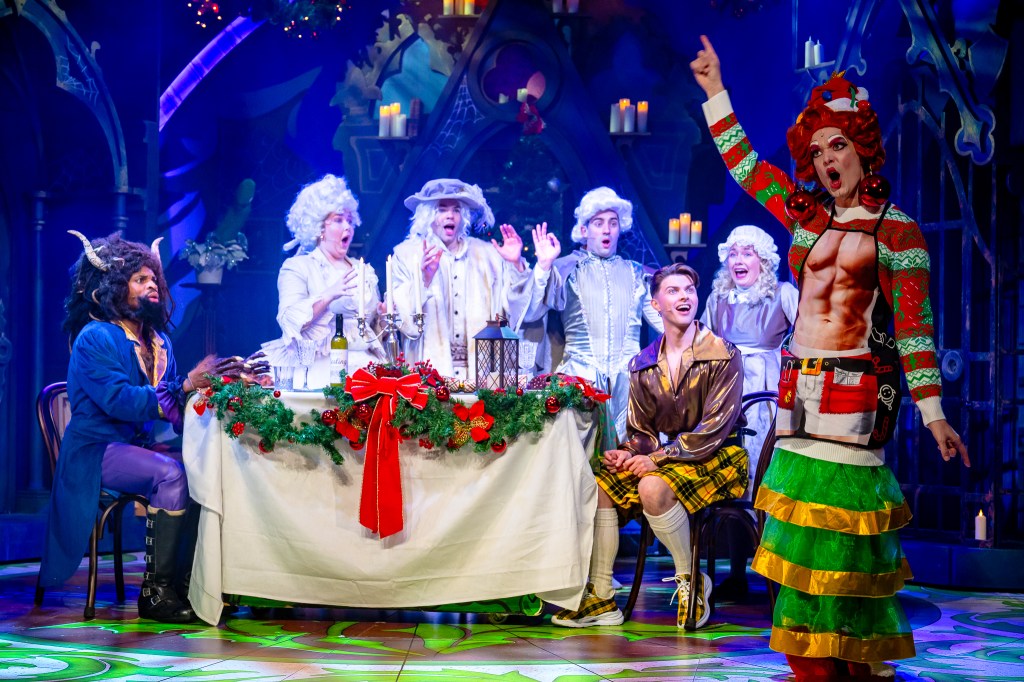
Matt Kennedy’s Bertie proves an endearing and effective protagonist, his charm grounding the chaos around him. Vocally strong and warmly played, he anchors the production, while his costume: a yellow bucket hat, wellington boots, and waterproof overalls, cleverly reinforces the affectionate stereotype the show knowingly leans into. His sister Bonnie, played by Laura Anna-Mead, is equally delightful, seamlessly oscillating between energetic naïveté and speechless, lovestruck lesbian. The versatility required of the cast is considerable, and nowhere more apparent than in moments of multi-roling; Anna-Mead’s take on the ghost of Megan establishes such a stark difference in characterisation that I had to do a double take.
Chris Lane as Cornelius, the villainous antagonist, is another highlight. His camp physicality and relish for insult establish him as both threat and comic tool, with a confident command of the audience that never falters. His presence injects a sharpness into the humour, ensuring that the show’s irreverence never slips into laziness.
While the show’s memorability largely rests on its outrageous humour, it would be remiss not to acknowledge its visual strengths. The set design by David Shields is impressively detailed, transforming the stage into something akin to a snow globe, a fitting choice for the snowy Scottish Christmas setting. It feels warm and oddly homely, a subtle but effective nod to the idea of queer space as somewhere safe and celebratory. The Dame’s shop is richly realised, while the Beast’s castle, particularly once “Christmasified,” is both looming and visually striking. Seamless set changes further attest to the strength of the stage management team, headed by James Prendergast, allowing the pace of the comedy to remain uninterrupted.
If this is your first foray into adult pantomime, or if you’re a seasoned panto warrior, Beauty and the Beast: A Horny Love Story is likely to be right up your street. Silly, obscene, and violently funny, it is not for the prudish; but, for those willing to embrace its grotesque joy, it offers a festive night out that feels both chaotic and surprisingly well crafted.
Beauty and the Beast: A Horny Love Story is running at Charing Cross Theatre until January 11th, 2026. Get your tickets here.
Image credit: Steve Gregson
 @ALEXROYTHEATRE
Leave a comment