The beginning of December marks the return of panto season, and York Theatre Royal’s 2025 offering, Sleeping Beauty, bursts with all the joyous excess one could hope for. This is a pantomime which is loud, irreverent, knowingly silly, and anchored by a cast who understand exactly what makes pantomime so unique. If it occasionally veers a little too far into self-referential territory, it remains an undeniably entertaining and impressively crafted night at the theatre.
The story of Sleeping Beauty unfolds much as you’d expect: Princess Aurora, the vindictive Carabosse, and an ever-looming spinning wheel. Yet writer Paul Hendy introduces one clever reframing by setting the narrative on the final day of term, situating Aurora in a school environment that immediately refreshes the arc of a tale we all know and love. From the outset, audience immersion is treated not as a bonus but as a necessity. The show opens with the ensemble – festively clad in Christmas jumpers – pouring through the stalls and circle, encouraging clapping, dancing, and waving in what becomes the first of many full-house warm-ups. A bright, lively rendition of Good Day, Sunshine! ushers us into Aurora’s world, the countdown to her eighteenth birthday underway, and the silliness abundantly clear.
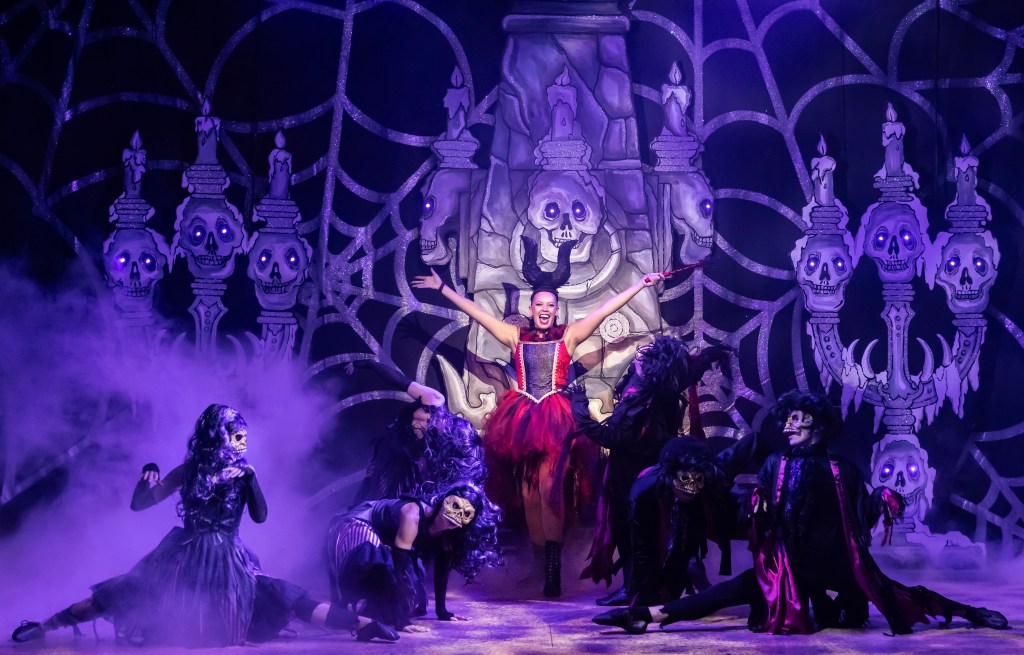
What follows is a production distinguished by its inventive re-imagining of classic panto set pieces. The much-loved “We’ll have to do it again then” routine, traditionally set in the woods, is relocated into a bedroom – a shift that proves unexpectedly fruitful. Spiders, skeletons, Frankenstein, ghosts: the usual ghoulish procession appears, but in a configuration that feels smarter, sharper, and gleefully heightened (accompanied necessarily by a joke about an immense budget). Act Two brings another moment of thoughtful reinvention, with the customary “12 Days of Christmas” style comedy number replaced by Who Do I Want to Be?, a joyously chaotic sequence featuring everyone from footballers to filmmakers, a water-gun wielding fireman, and a baker and decorator, all making exuberant use of a pulled-out tarpaulin floor and the inevitable panto mess. This sort of conceptual renewal is threaded throughout the production, and it creates an evening that honours tradition without being beholden to it.
The technical spectacle this year centres on Kevin, a so-called “vicious velociraptor” – a remarkable, life-sized dinosaur accompanied by a fire show that left the audience visibly enthralled. Kris Madden, acting as the Raptor’s Guardian, handles the moment with an inherent theatricality, harbouring the energy of evening holiday entertainment; it is an undeniable showpiece, and as impressive as any flying carpet or enchanted vehicle of pantos past.
At the core of the production’s success, however, is its cast. Robin Simpson once again proves himself the heartbeat of York’s panto in his wildly freewheeling turn as Nurse Nellie. His partnership with Tommy Carmichael’s Jangles the Jester is a masterclass in comic synchronicity: both performers effortlessly combine musical theatre meta-humour with razor-sharp improvisation, consistently sending the audience – and each other – into fits of laughter. Jocasta Almgill’s Carabosse is a standout, balancing gorgeous villainy with genuinely formidable presence. Her introductory line-up of iconic villains (“Voldemort, Jezebel… Farage”) lands perfectly, and her rendition of Hellfire – a delightfully meta-theatrical choice – showcases vocals of extraordinary clarity and power. Richard Williamson’s red-hued lighting in this number is one of the production’s aesthetic peaks.
Making one of the most well-rounded pantomime heroines I’ve seen in York, Aoife Kenny’s Princess Aurora is charismatic and assured, her vocal and dance ability given space to flourish rather than being undermined by the chaos. Opposite her, Christian Mortimer is an affable, charming Prince Michael, leaning into the humour while maintaining an earnest warmth. The ensemble, though arguably underused, demonstrate impeccable discipline and energy, with Hayley Del Harrison’s lift-heavy choreography executed with professionalism and flair. Elijah Daniel James emerges as a particular standout, and Charlotte Rose O’Sullivan’s knowingly over-exaggerated comic lines and expressions bring a welcome dash of personality.
Yet, for all its heart and invention, the production is not without its limitations. Its greatest hurdle is an overreliance on self-awareness. While self-referential humour is a beloved staple of pantomime, Hendy’s script leans on it so heavily that it occasionally eclipses humour rooted in character or narrative. At times, it feels as though the show is pre-emptively apologising for itself – as though self-deprecation might shield it from the accusation that panto is somehow lesser. The irony, of course, is that this production has the ingredients to be a genuinely strong piece of theatre in its own right; if it trusted that fact a little more, rather than undercutting itself, it could reach even greater heights. That said, when the meta-humour lands, it really lands. Almgill’s deadpan “three years at RADA for this” or the gracious nod to the oft-forgotten “unnamed villager number one” elicited huge, deserved laughter. Other moments however – most notably the “6–7” gag – left sections of the audience bewildered, particularly older theatregoers, and may struggle to sustain momentum as the run continues. Likewise, the quantity of audience callbacks, three or four to hold in mind, was embraced enthusiastically on press night, but may prove a touch ambitious for a quieter January crowd.
What the show absolutely nails, however, is the illusion of spontaneous chaos. Scripted mishaps appear accidental, character breaks unfold with gleeful precision, and the overall veneer of unpredictability is carefully controlled. The bed sequence in the “We’ll have to do it again then” routine is executed with impeccable comic timing, and the confetti cannon interrupting Mortimer’s soulful number was an inspired stroke of mischief.
Musically, Edwin Gray’s arrangement and direction elevate the production significantly. The school sequence – with visual nods to Everybody’s Talking About Jamie in the school sequences and a mash-up of School’s Out, ABC, and Do-Re-Mi – is particularly well realised, and the inclusion of Golden feels like a signature panto moment this year: warmly familiar, yet well deployed.
Perhaps the strongest design element of the entire production is its costuming. Terry Parsons, Amy Chamberlain, Ella Haines, Michael Batchelor and Joey’s Dame Creations deliver a cohesive, imaginative visual identity: from Fairy Moonbeam’s crescent-adorned gown to Carabosse’s Maleficent-esque headpiece, every costume feels theatrically considered. In this vein, comedy too prevailed through costume, with the prisoner get-ups having 24602 plastered on the chests and backs – this was brilliant. The finale, with the full company in pink, is a vibrant nod to the iconography of Sleeping Beauty, while the masked skeleton ensembles evoke a subtle Wicked influence. It is a genuinely impressive achievement.
Ultimately, Sleeping Beauty at York Theatre Royal is a buoyant, big-hearted pantomime that revels in the joy of its own theatricality. Though occasionally weighed down by an excess of self-referential humour, it remains a vibrant, inventive and technically ambitious production. With a cast firing on all cylinders and design elements that dazzle, this is a wonderfully festive start to the season.
Sleeping Beauty is running at York Theatre Royal until January 4th, 2026. Get your tickets here and find out our their 35Live scheme here.
Image credit – Pamela Raith
 @ALEXROYTHEATRE
Leave a comment