Returning to Brixton House this week for Limp Wrist and the Iron Fist was an utter joy. Emmanuel Akwafo’s new play thrums with defiance, humour, fear, and above all, friendship. It is a portrait of queer life painted in flashes of neon, streetside shadows, and moments of aching stillness. Think flamboyance, tension, and friendship: it is the exploration of these themes narrating the fragility of the Black, queer, human experience that culminates in the brilliance of this piece of new theatre.
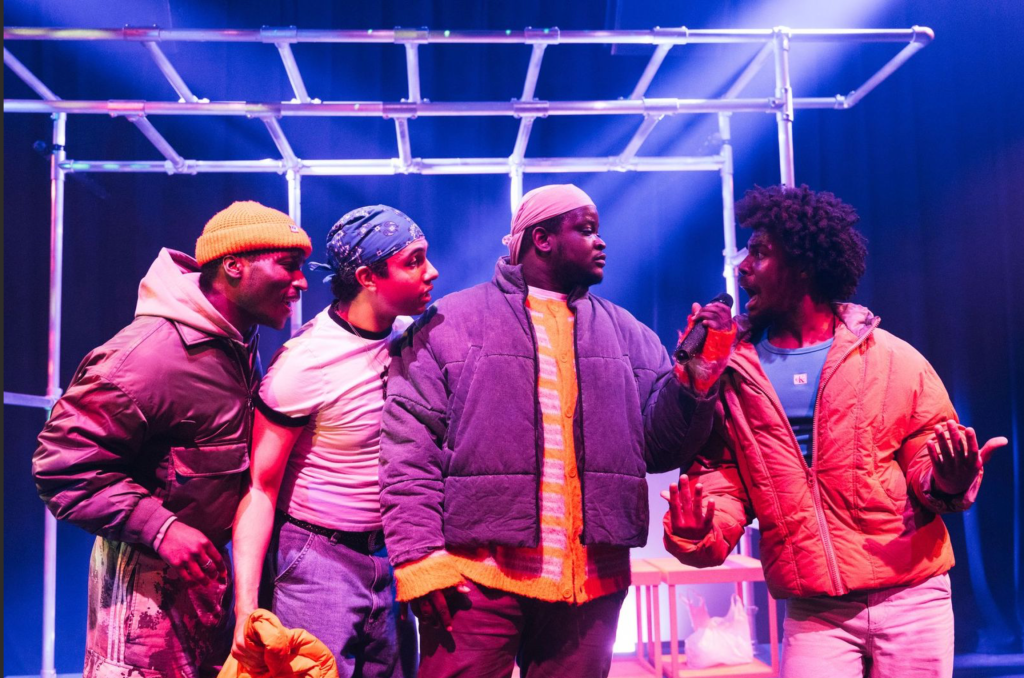
The story follows four young men—Nathaniel (Noah Thomas), Monday (Prince Kundai), Joseph (Romeo Mika), and Omari (Tyler Orphé-Baker)—over the course of a single night in London. We meet them at a bus stop, teasing each other, cat-walking across the pavement, and slipping into private jokes. By the time dawn arrives, we have watched them move through a club, through the teeth of memory, through arguments and affection, and finally to the banks of the Thames, where exhaustion and vulnerability strip them down to their cores. In the space of one evening, Akwafo packs in the full spectrum of emotional capacity: resentment, insecurity, joy, devotion, and the quiet bravery of choosing to show up for one another, and vitally, for oneself.
The play’s greatest achievement is its deft balancing of tone. One moment, we are in a RuPaul’s Drag Race-adjacent bit of camp brilliance, with the boys sashaying down the imaginary runway to a chorus of “we at the bus stop” while jokes about “Narnia realness” (a nod to the symbolic ‘closet’) soar with gleeful absurdity. The next, time seems to stop. Joseph is pulled into a memory, landing with devastating clarity. Jahmiko Marshall’s clever lighting design snaps us out of the silliness, instead plunging us into the visceral fragility of Joseph’s queer experience. It’s a tonal swerve handled with such precision that the audience barely feels the transition; it hits simply, sharply, truthfully.
Much of the play’s emotional resonance rests on the performances of its cast, who work with a synergy that feels lived-in and unforced. Tyler Orphé-Baker’s Omari is the comedic anchor of the group: dry, grounded, and radiating the kind of warmth that makes his presence indispensable. Through him, the authenticity of the friendship—its rhythms, its comfort, its unchecked chaos—is constantly reaffirmed. Prince Kundai’s Monday sits in beautifully tense contrast. He is sharp, almost bristling, a portrait of someone carrying the weight of systemic oppression without the language to unburden himself safely. His anger is not villainous but deeply human—a reminder that marginalisation leaves marks that don’t always rise to the surface politely. Monday is morally complex, dragging the big picture into the room when no one wants to confront it.
Romeo Mika, as Joseph, delivers the most fragile performance of the quartet. There is something unbearably tender in the cardigan-wrapped softness of his early scenes—a visual vulnerability that sets the stage for the searing monologue at the play’s climax. Mika accesses something raw, trembling between fear and hope, turning Joseph into a quiet centre of gravity. His is a performance that doesn’t demand empathy but quietly earns it.
Noah Thomas’s Nathaniel, who may well give the standout performance of the evening. Thomas carries much of Akwafo’s quick-witted humour with delicious subtlety; the throwaway quips land with precision, and his meta-theatrical “there’s no place like home,” complete with heel-clicking, is a moment of pure comic gold. Yet Thomas’s true brilliance emerges when Nathaniel is pushed to confront his mixed-race identity—particularly in scenes with Monday, where humour falls away to reveal something far more delicate. His emotional openness renders the play’s political commentary not only intellectually compelling but personally affecting.
The cast, individually superb, become extraordinary when working as a unit. They breathe life into the tensions at the heart of the piece: laughter and grief, queerness and danger, solidarity and fracture. Their interplay forms the emotional architecture upon which the play stands.
Director Nathanael Campbell capitalises on the cast’s kinetic energy, orchestrating movement sequences that are electric without feeling gratuitous. Yet, his most striking directorial choice is one of stillness. After Joseph’s climactic monologue, the action softens into a wordless tableau of friendship: one by one, each boy reaches out to Joseph—head on shoulder, hand on back, an embrace that lands with the gentleness of a promise; Monday hesitates. His guardedness is a character trait built across the evening, and his eventual yielding becomes one of the most moving beats in the production. Campbell understands precisely when to let silence do the talking.
All of this is held together by Amelia Jane Hankin’s set, a static scaffolded structure echoing a bus stop. It is deceptively simple—metal bars and levels—but its verticality allows the cast to create images that feel unexpectedly cinematic. Characters climb, lean, hover, perch; the space becomes not only a bus stop but a club, a memory, a riverside, a world in which elevation becomes both literal and symbolic. It is a small stage, but Campbell and Hankin make it feel endlessly pliable.
Limp Wrist and the Iron Fist is not merely a play about queerness, nor solely about race, nor even about friendship—it is about the delicate line between safety and danger, joy and grief, freedom and fear. It is about the worlds queer people build in order to survive, and the ways those worlds can erupt into brilliance despite everything pressing against them. Brixton House has staged something vital, exhilarating, and deeply humane.
Perhaps that is its quiet triumph: in a world that often forces queer experiences into extremes—either tragedy or spectacle—Akwafo’s play insists on something messier and more truthful.
Limp Wrist and the Iron Fist is running at Brixton House until November 29th. Get your tickets here.
Image credit – Helen Murray
 @ALEXROYTHEATRE
Leave a comment