Halloween may be over, but appetite for a good fright lingers, haunting theatres across the country with ghost stories. I had the honour (or terror?) of experiencing Charles Dickens’ The Signalman at the Darlington Hippodrome this week; it is a production that proves just how chillingly potent a well-told tale can be.
From the moment the audience stepped into the auditorium, Michael Lunney’s design began its quiet work. An eerie wind echoed through the stalls, and the house lights remained defiantly on, immersing the audience in the production before the curtain had risen. Dickens’ short story is a tightly wrought piece, focused on the unlikely relationship between a curious traveller and an increasingly haunted signalman. In Francis Evelyn’s adaptation, this dynamic remains central: John Burton’s gentleman visitor arrives with polite intrigue, only to be drawn ever deeper into the signalman’s dark confessions, each revelation hinting at a reality teetering between psychological torment and the supernatural.
Dickens’ concept behind this story is remarkably clever in striking the perfect balance between shock, fear, and comedy. While a handful of plot developments were somewhat predictable – dampening the shock that seasoned horror-goers may anticipate – the production compensates with several sharply executed twists, ensuring the unravelling remains engaging. Evelyn’s adaptation embraces a bold choice: it leans proudly into telling rather than the oft-prescribed “show don’t tell.” Yet this very insistence becomes its strength. Through monologue and memory, the play transforms into not merely a ghost story, but an exploration of the signalman’s own hauntings: spectres of fear, guilt, and isolation. His retellings, rich with conviction, summon an array of responses: fear, awe, amusement, and, ultimately, aching sympathy.
Much of this emotional breadth rests on the shoulders of Chris Walker, whose performance as the Signalman is nothing short of magnetic. Left alone on stage for a huge portion of the performance, he commands the space with quiet authority, his silence as telling as his speech. His initial mild, almost endearing reserve gradually gives way to something far more chilling – an inner unraveling portrayed with an honesty that pulls the audience irresistibly into his fractured world.
Such a performance flourishes under intelligent direction, and Michael Lunney’s hand is evident throughout. His attention to detail grounds the story’s Victorian setting with subtle authenticity. One particularly striking example lies in the simple act of lamp-checking: performers momentarily blind the audience with their handheld lamps, a gesture that initially feels abrasive until, by the second act, its practical logic became clear to me. It is precisely what a signalman would do: sweeping the track for oncoming trains. These unhurried, methodical movements heighten the production’s low simmer of dread. Lunney’s directorial instincts shine further in the scene of the traveller’s letter, rendered through voiceover. By freeing John Burton (as the traveller) from the constraints of reading aloud, the production allows him to “act between the lines,” creating a moment of poignancy that lingers. Occasional line stumbles (insofar as they are covered commendably by Walker’s fragile, haunted demeanour) momentarily fractured the immersion, and a few exchanges suffered from slightly stiff delivery. The production’s authenticity thrives on subtlety; a deeper relaxation into the rhythm of the dialogue would allow this subtlety to fully take root.
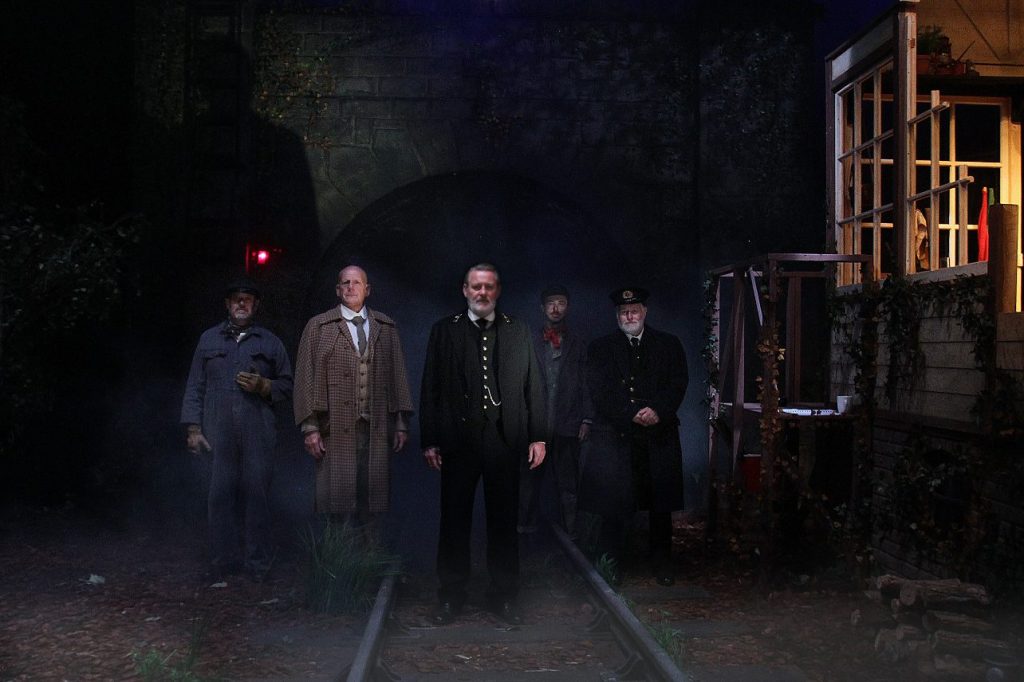
What cannot be faulted, however, is the breathtaking set. When the curtain first rose, the audience collectively gasped, and rightly so. A rugged stone tunnel dominated centre stage, complete with an uncannily real set of tracks stretching downstage. A clever CGI projection by David Moulder suggested endless depth beyond the tunnel’s mouth, creating an illusion of perpetual distance. Stage left stood a raised signal box, its exposed interior reminiscent of recent stagings of An Inspector Calls, inviting the audience to peer directly into the character’s private world. Much of the production’s most effective horror unfolded here, with understated jump scares and inventive prop use delivering moments of sharp, unsettling tension. The choice to maintain a largely unchanged set proved wise; its persistence became a kind of visual anchor, enhanced by seamless scene transitions aided by Lynette Webster’s musical underscoring and a faultlessly coordinated stage management team led by Jeremy Barnaby and Chris Redford.
Ultimately, this production of The Signalman comes tantalisingly close to perfection. Its blend of humour and horror, its commitment to Dickens’ timeless storytelling, and its richly atmospheric staging make it a compelling seasonal treat. With a touch more ease in dialogue delivery, it would be an undisputed triumph. Still, for those nursing post-October blues, longing for one last fright before winter sets in, this haunting gem at the Darlington Hippodrome may be just the thing.
The Signalman runs at the Darlington Hippodrome until Saturday 8 November 2025. Get your tickets here.
Image credit – Mat Larkin/Middle Ground Theatre Company Ltd
 @ALEXROYTHEATRE
Leave a comment