Graeae Theatre Company’s Bad Lads at Live Theatre is a harrowing portrayal of the horrors endured at Medomsley Detention Centre — but more than that, it is a reclamation of voice, dignity, and truth. What unfolds is not a play that seeks entertainment, but illumination. Bad Lads holds up a mirror to one of Britain’s most shameful institutions, where state-sanctioned cruelty was disguised as reform. The production treads the line between testimony and artistry with remarkable poise: unflinching, yet never gratuitous; political, yet deeply personal.
The play follows Jackie, over the course of his three months at Medomsley — a detention centre near Consett, County Durham, operating between the 1960s and 1980s. In this centre, young men were subjected to physical, psychological, and sexual abuse under the guise of “correction.” Marketed as a “short, sharp, shocking” intervention for wayward youth, Medomsley became a site of dehumanisation.
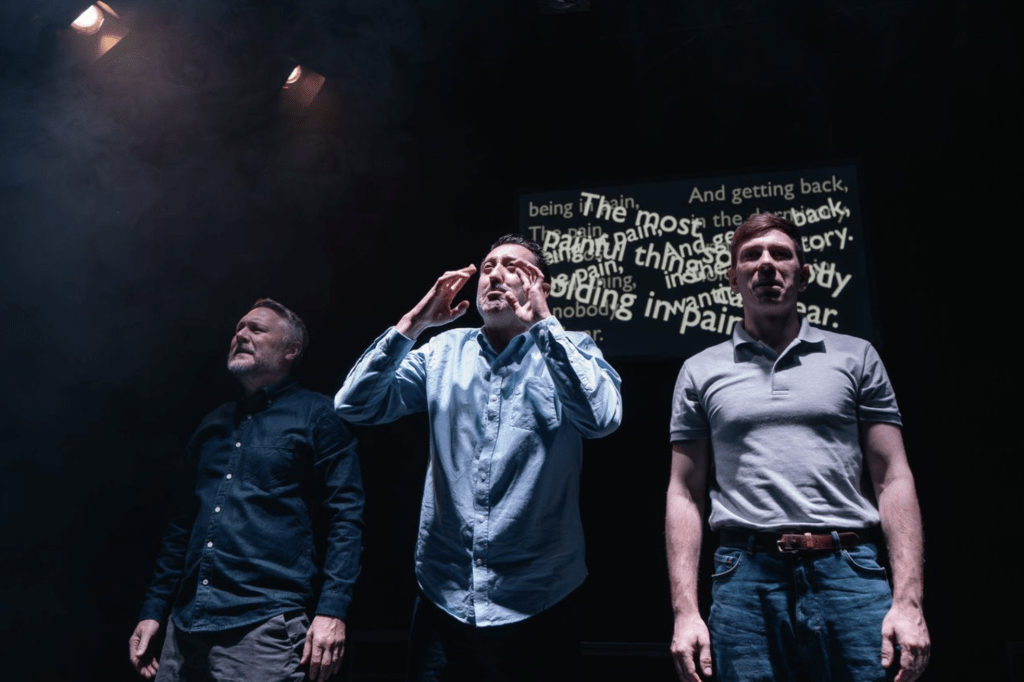
On stage throughout are three versions of Jackie: Older Jackie, Younger Jackie, and Jackie who signs. The story unfolds as both a direct address to the audience and an intimate conversation between versions of the same man. This interplay forms the production’s emotional core — a dialogue between memory and self, past and present, silence and expression.
Framed by the projection of the words “This play is short, sharp, and shocking” above the stage, the piece reclaims the cruel rhetoric of Thatcherite reform. Initially, I admired it simply as a striking bit of sibilance — neat, emphatic, rhythmic. Only later did I realise its historical weight. The phrase was not theatrical invention but political justification: the language used to sanction suffering. In reframing it, the production exposes the chilling ease with which violence can hide behind policy.
Director Jenny Sealey delivers a masterclass in humanity. Her staging is taut and purposeful, avoiding spectacle in favour of stillness and suggestion. The brutality is not shown; it is felt — in silence, in breath, in the way a body freezes. The relationship between Older and Younger Jackie is delicately drawn, revealing the psychological aftershocks of trauma decades later. Sealey captures PTSD not as melodrama but as memory looping endlessly — the inability to leave a room that no longer exists.
The cast of three were uniformly exceptional. Danny Raynor as Older Jackie embodied a man haunted by what he cannot forget. His range was astonishing: one moment trembling with quiet fragility, the next metamorphosing into the menacing figure of ‘Husband,’ Jackie’s abuser. The transformation is chilling in its immediacy. Robin Paley Yorke (as Younger Jackie) brought to life a character on the cusp of destruction. His performance was nuanced, understated, and heartbreakingly compelling — the vulnerability of a boy who should have been safe, crushed by the system that claimed to save him.
Craig Painting (Performance Interpreter) acts as a bridge between them, both narrator and embodiment of the inner world. His signing transcends translation; it becomes choreography. Through his expressive physicality, the audience glimpses Jackie’s unspoken emotions — the anger, the shame, the flickering moments of hope. It is one of the most inventive integrations of access and storytelling I have ever seen.
Accessibility is not a footnote to this production — it is its pulse. Signing, captioning, and audio description are not add-ons, but dramaturgical tools woven seamlessly into the fabric of the piece. Captions hover above the stage like ghostly echoes; the signed performance becomes an extension of Jackie’s psyche.
Outside the auditorium, a sensory desk provides visual aids, fidget toys, ear defenders, and other supports for audience members — a thoughtful touch that mirrors the care taken onstage. This is a hallmark of Graeae’s work: accessibility not as obligation, but as art form. In Bad Lads, this takes on a striking resonance. A story once silenced is now told in every language possible — including the languages of access and inclusion.
The set, stripped to its bare essentials — a cold metal table, two chairs, a single lamp — evoked an institutional sterility that is both literal and psychological. This minimalism allowed the performances to carry the full weight of storytelling, unhindered by distraction. Lighting design by Lucía Sánchez punctuated this necessary darkness with precision. In one poignant discussion of the shame felt by Younger Jackie, he is at once cast into darkness upstage as his silence swells: a visual embodiment of this shame and suppression being discussed. The absence of light becomes its own kind of testimony, and further bolsters Graeae’s success in physicalising the emotional weight of the horrors.
This production is a triumph of empathy, craft, and courage; Bad Lads stands as both remembrance and reckoning. It honours the survivors of Medomsley, exposes the machinery of cruelty that sustained it, and insists that we, as witnesses, cannot appeal to ignorance.
This is theatre at its most vital — not comfortable, not polite, but necessary. It leaves you altered: quieter, angrier, more aware. Bad Lads does not simply tell a story; it breaks a silence.
Bad Lads is running at Live Theatre, Newcastle until Saturday 11 October, before embarking on a UK Tour. Get your tickets here!
Image credit – Von Fox
 @ALEXROYTHEATRE
Leave a comment