The autumn theatre season has commenced at Greenwich Theatre with a revival of Jim Cartwright’s Two – what could feel more autumnal than settling into a pub, pint in hand, watching lives unfold around you? Cartwright’s play is a portrait of the ordinary and the extraordinary colliding over one evening, a piece that has been revisited countless times since its Bolton premiere.
This play is not a new one. Written by Cartwright, premiering in 1989, this particular iteration leans into those 1980s roots, these aspects landing marvellously with the audience. This artistic choice – best evidenced through the vibrant costume design, with colourful windbreakers, little pencil skirts, and even an argyle sweater – grounds the play in its original era. Although this could risk alienating younger audiences, the consensus on Thursday evening was a great one – the ‘80s touches were received warmly, with such risk reaping reward!
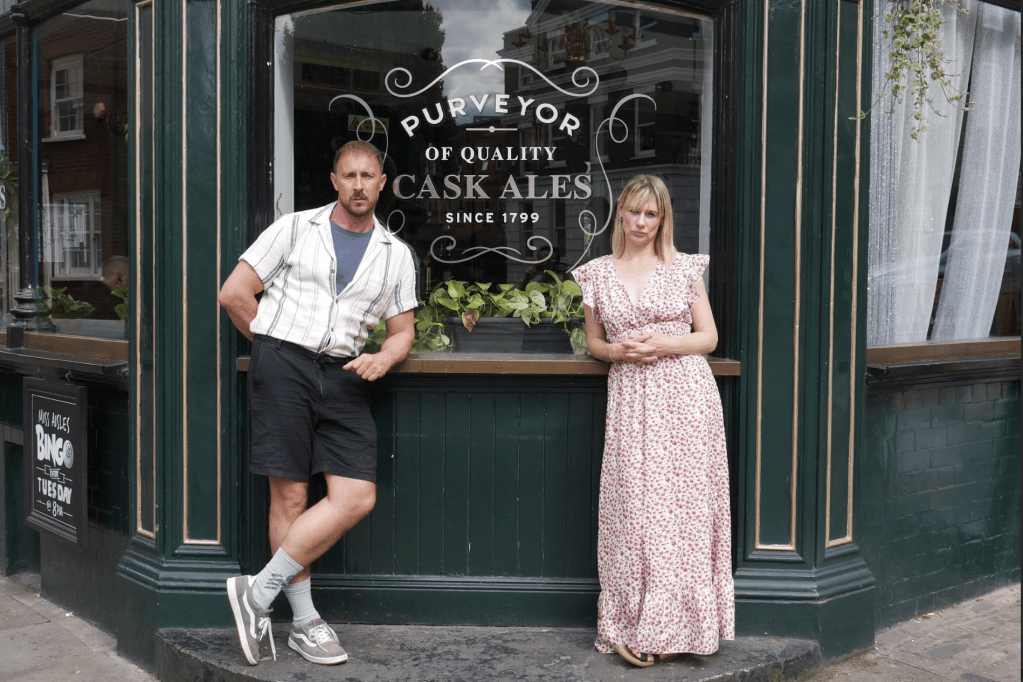
I was first struck by the immersive staging. The café/bar/studio space of Greenwich Theatre has been opened up and transformed by Jana Lakatos into a cosy pub, ’The Clock and Compass’: beer mats scattered, table football and a slot machine in the corner, all against the backdrop of ‘80s classics. Each audience member received a free drinks voucher redeemable at the working bar – both the usual bar and now part of the set – before performers Kellie Shirley and Peter Caulfield integrated themselves into the bustle. In this capacity, there is no clear “beginning” to the performance; rather, it emerges organically from the atmosphere of the pub. This is a clever touch, reminiscent of The Choir of Man and an early indication that director James Haddrell understands the subtlety needed to bring Cartwright’s work to life.
Anybody who knows me, knows that above all else, my theatrical heart resides with two-handers. This facet of the show is the material’s biggest strength. Across the evening, the pair of performers inhabit fourteen characters: from the pub’s landlord and landlady, to a lonely pensioner, a weary caregiver, and a young man with a wandering eye. Shirley and Caulfield provide a masterclass in effective characterisation, fore-fronting their strength and versatility both as individual performers, and as a dynamic duo. Each vignette is distinct, aided by regional accents (which were endearingly true to the production’s inherent northern core), physicality, and costume shifts. These quick transitions were executed seamlessly, disguised by the natural rhythms of pub life – glasses being cleared, or crates crashing backstage.
The material itself, however, is lacklustre at times with pacing problems persisting. The first act ambles, offering a montage of pub regulars but little narrative drive. It left me at the interval entertained but questioning the purpose of the story. Act Two begins with an emotional jolt: an uncomfortable scene of domestic abuse that forces the audience into complicity through silence. It’s powerful and disturbing, a rare moment when the immersive staging heightens the play’s tension. Yet this tonal depth quickly dissipates as the show reverts to lighter sketches before cramming its emotional climax – the revelation of the landlords’ own grief – into the final ten minutes. The eruption is affecting, but the pacing makes it feel rushed, more like an emotional whiplash than a carefully built crescendo.
Whether this structural imbalance is Cartwright’s or this production’s, the effect is the same: the resolution doesn’t quite earn its weight. Still, the strength of the direction and the performers’ versatility carry the evening. This staging captures both the spirit of the local pub – a place of laughter, quarrels, and community – and the potential of a two-hander to hold an audience with nothing more than two people, a bar, and sharp character work.
At its heart, Two remains an affectionate portrait of pub culture, celebrating the ordinariness of its patrons while hinting at the struggles they conceal. This Greenwich revival doesn’t resolve the play’s inherent unevenness, but it makes a persuasive case for its continued relevance. And if nothing else, it’s a great night out over a pint.
Two runs in the café/bar space at Greenwich Theatre until 21 September 2025. Get your tickets here.
Image provided by the production.
 @ALEXROYTHEATRE
Leave a comment